
Profile: Kevin Gundle of Aurum Funds
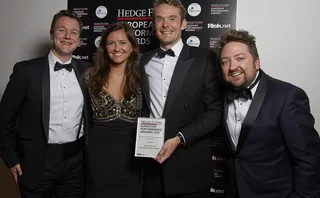
Kevin Gundle, CEO of Aurum Funds, accepted Hedge Funds Review’s award for Lifetime Achievement at the 2014 European FoHF Awards in London. He speaks about his journey to set up Aurum
In the Academy Award–winning documentary film Searching for Sugar Man, South African fans track down folk musician Sixto Diaz Rodriguez, dispelling widespread rumours percolated in the apartheid era that the cult figure had committed suicide, perhaps by setting himself on fire during his last stage performance.
For Kevin Gundle, Rodriguez’s tuneful, anti-establishment musings were the soundtrack to his youth, songs that served as anti-apartheid anthems in South Africa. Gundle was also among those who believed the myth that Rodriguez died by self-immolation, or by shooting himself or that he simply wandered off into the hills and vanished.
A spell in the South African army at age 18 – that left him feeling uneasily complicit in the morally reprehensible policies of the government of the day – confirmed in Gundle the determination to complete his own disappearing act.
In 1987, within six months of leaving the army, Gundle had packed his bags and decamped to the UK. “Politically at that time, it wasn’t a place where I was comfortable,” he says.
The move proved a huge success for Gundle, his business partners and those associated with them. As chief executive of Aurum in London, the man from Johannesburg oversees an organisation that in August celebrated a two-decade track record of creating customised fund of hedge funds (FoHF) portfolios for institutional investors.
Aurum’s beginnings were modest, cooked up with his business partner and Aurum chief investment officer Adam Sweidan and his father Clifford Gundle around a kitchen table in 1993, but the firm has gone on to become distinguished for its disciplined investment process using proprietary software and computer systems – built on Gundle’s forte as a computer engineer. Technology has been an important feature of Aurum’s development in creating its research, client services, administration and reporting platforms.
He says: “I think like a computer programmer, but am also passionate about the markets. At university I was writing software programmes to measure fund performance and I built a fund manager database. The breakthrough came when I could compare the performance of different managers with different time series of data. It took us a long time until we got to $100 million in assets under management, but our database systems were ahead of the game.”
Building its own data management capabilities in-house has meant that Aurum has been assured of continuity in its systems from day one. “We’ve never restated a net asset value in our flagship funds in 20 years and reconcile to the penny with Northern Trust every month,” he says.
In that time, “we’ve endured some of the most challenging market conditions in living memory,” says Gundle, but from a humble set-up in Bermuda the firm is now housed in offices in two additional jurisdictions – South Africa and the UK. Gundle ponders the approach the company has adopted: “There is an African proverb that says ‘If you want to travel fast, go alone. If you want to travel far, go together’.” Aurum could be a case study for the merits of collaboration and teamwork, he adds.
The company’s first three funds in 1994 were the Aurum Investor Fund, the Aurum Gold Fund and the Aurum Multi Fund, the latter made up of 10% Gold Fund and 90% Investor Fund. Today, Investor Fund has one of the longest track records for any multi-manager hedge fund and a compound return of 7% net for 20 years, noticeably outperforming global equity and fixed income markets over the same period.
But progress is often accompanied by complexity, which can be both a burden and an opportunity. This year has seen Aurum launch its first alternative investment fund managers directive (AIFMD) compliant FoHF. New regulatory restrictions that apply to promoting its range of products means that Aurum needs to continue to explore regulated products and structures.
Aurum continues to evaluate the options but Gundle is not convinced that liquid alternatives such as Ucits hold all the answers, questioning whether investors are really just paying for expensive beta. He says: “We have been asked to put together Ucits but up to now it is not something we have chosen to do. The restrictions and liquidity requirements are very onerous. Leverage and concentration in portfolio construction has always been an important part of hedge fund DNA. Not all Ucits funds will be able to provide the differentiated returns people are after and, unless that is something Aurum are able to offer, it is not something we would do.”
Likening alternative Ucits to the once-popular 130/30 funds, Gundle says “they’re about as close as hedge funds got to Ucits pre-crisis, and the financial crisis cleaned them out. Some converted into Ucits, some went by the wayside.” Gundle particularly questions the ability of some strategies – such as certain macro, credit and various event driven strategies – to offer the level of liquidity and compliance mandated under the alternative Ucits brand.
He explains: “It has been some time since these products have been tested in an environment where the S&P 500 is down 10% in a month. When volatility starts picking up, those chickens might just come home to roost. I’m also concerned about some of the large Ucits funds. Do they have the requisite liquidity and process in place to deal with substantial investor redemptions? We haven’t been tested but at some point we will be, like hedge funds were in 2008.”
Gundle’s concerns over regulation extend to AIFMD, where the costs of compliance and often confusing and inconsistent implementation will result in a reduction of choice available to investors. He says: “Lots of good US and non-EU managers have stopped promoting their products in Europe. As a consequence investors don’t know they exist.”
Elsewhere on the fund of funds landscape, he believes regulators should take a closer look at the power exercised by consultants managing money in implemented consulting deals, as they lack the mechanisms to dispassionately assess their own performance relative to other options. “About 80% of such fiduciary mandates don’t go out to tender as it’s not in the consultants’ interests. Consultants have said publicly, why would they invite their competitors to pitch against them? Trustees should insist on fund management tendering irrespective of whether they’ve got a consultant managing some of their money.”
Picking winners for an evolving client base
Aurum’s client roster has changed significantly over time. Gundle says a common misconception persisted for some time that Aurum was a family office, as many of its clients were high-net-worth individuals gathered from family, friends and associates. Twenty years on, its range of clients is far more diverse; almost 70% are institutions including charities, pension funds and sovereign wealth funds.
The firm registered early success following its launch by selecting managers including George Soros, Louis Bacon, Julian Robinson, Michael Steinhardt and Tudor Investment Corp. Gundle says Aurum has sought to position itself as a pure alpha organisation – in its flagship fund and managed accounts it has very little long/short equity and looks to provide a package of investment outcomes, with low volatility and low beta being central to the results Aurum strives to deliver. There are very few event driven strategies in its portfolios and no direct credit or CTA managers.
Gundle says: “You’ve got to offer investors the reassurance that their money is being managed in a way that is complementary to what they already own. That’s where we’ve distinguished ourselves from conventional multi-manager solutions. We almost go as far as defining our approach by what we don’t invest in. Consequently, our beta and correlation is extremely low. I have my partner Adam to thank for Aurum’s track records. Adam is an incredible investor.”
Although Aurum does invest in emerging talent, the barriers to entry are much higher and the firm is conscious of not wanting to position its proposition as giving clients access to early stage managers, because of the significant operational risk this incurs. Gundle says: “The attrition of early stage managers is extremely high, so very often we pass as we are not prepared to take a punt using our clients’ capital. You don’t recover from operational risk. You can recover from investment risk – and that’s how you make your money – but operational risk is something more sinister.”
To defray operational risk, Aurum deploys a due diligence process that gives its head of that function a power of veto. Gundle says: “There are no sacred cows. The operational due diligence team can veto a long-standing investment, or one the investment team are doing research on.”
When has the veto been used? Gundle gives an example: “Weavering.”
The UK macro fund that went under in 2009 had an affiliated Cayman counterparty that wrote a big swap with it to gain leverage. Aurum never had an investment in Weavering, but when the hedge fund blew up, Aurum immediately asked searching questions of itself around how it might have been caught up in a similar mess. Its operational due diligence team conducted an investigation to ensure it was aware of where there were affiliations between its managers and their counterparties. He says: “We got managers to disclose the products they trade with each counterparty and whether there was an affiliation. None had an affiliated counterparty, but one manager we had money with didn’t want to disclose. They had done well for us so it was a difficult conversation. We asked them ‘why are you being so difficult’? They said ‘if we tell you we’ll have to tell everybody’. So we redeemed.
“That manager carried on and still has many billions under management, but we are great believers in applying lessons learnt and avoiding bear traps. That’s why we’re still in business after 20 years.
“I don’t think people give us money to make a lot of money, but rather to generate a satisfactory differentiated return stream. The starting point is, don’t lose money.”
Ark angels
In accepting Hedge Fund Review’s 2014 European FoHF Lifetime Achievement award, Gundle – a young 50 – is keen to emphasise: “I’m not going anywhere for at least another 10 years! We have no plans to sell. Plenty of people – such as private equity firms, FoHFs that want to gather assets and insurance companies – want to talk to us about buying Aurum. But it’s got to be something special we’ve yet to see before we would consider selling.”
Aurum can attribute its consistency and longevity to many reasons but low staff turnover is a key factor among them. Utilising incentives that reward continued service, Aurum employs 50 people, half of whom have been with the company for more than five years.
That burning desire to carry on doing what he is good at and continuing to build the firm extends to Gundle’s interests beyond finance. Outside steering a fund management company, Gundle has also made his mark as a force for good by his involvement with charity Absolute Return for Kids (Ark), manifesting Aurum’s aspiration to act as a catalyst for change to enrich and enhanced the lives of those less fortunate.
Ark was co-founded by a group of hedge fund financiers 12 years ago, including Paul Marshall and Ian Wace of Marshall Wace and Arpad Busson of EIM Group. More than 430,000 children have benefited from Ark, which has raised more than £180 million, matched by a further £460m from government and partners such as Comic Relief. In the early days, Ark ran the largest HIV intervention group in South Africa, with 120,000 people on treatment, and more recently has tackled diarrhoea in Zambia, education projects in India, school-building in Uganda and prevention of deaths during childbirth in Zimbabwe.
Gundle says: “We want to make a difference in an original and rigorous way.” Initially a grant maker, Ark now runs all of its own programmes and is one of the largest managers of academy schools in the UK. Concentrating on inner cities in 31 locations, with the aim of upping that number to 50 by the end of 2015, Gundle says Ark’s objective is to become the top manager of academy schools in the UK: “We’ve evolved into an education-centric charity because it’s what we do well.”
It is an ethos that has set Gundle and Aurum apart, and long may it continue.
Only users who have a paid subscription or are part of a corporate subscription are able to print or copy content.
To access these options, along with all other subscription benefits, please contact info@risk.net or view our subscription options here: http://subscriptions.risk.net/subscribe
You are currently unable to print this content. Please contact info@risk.net to find out more.
You are currently unable to copy this content. Please contact info@risk.net to find out more.
Copyright Infopro Digital Limited. All rights reserved.
As outlined in our terms and conditions, https://www.infopro-digital.com/terms-and-conditions/subscriptions/ (point 2.4), printing is limited to a single copy.
If you would like to purchase additional rights please email info@risk.net
Copyright Infopro Digital Limited. All rights reserved.
You may share this content using our article tools. As outlined in our terms and conditions, https://www.infopro-digital.com/terms-and-conditions/subscriptions/ (clause 2.4), an Authorised User may only make one copy of the materials for their own personal use. You must also comply with the restrictions in clause 2.5.
If you would like to purchase additional rights please email info@risk.net
More on Hedge funds
JP Morgan warns hedge funds to expect intraday margin calls
US bank may demand variation margin ‘up to seven’ times a day after Archegos default

Alternative markets give edge to Florin Court strategy
By concentrating on exotic and alternative markets, Florin Court Capital Fund has sidestepped overcrowding and correlation to the main trend following commodity trading advisers, offering investors a diversified alternative to the standard systemic macro…

Global macro views combine with quantitative models to produce consistent returns
The team behind River and Mercantile Group’s global macro strategy team operates under two key principles: that macro is the most important aspect of any investment decision and that decision-making should incorporate both systematic and discretionary…
On the offensive – Seeking a new edge, buy-side invests in portfolio and risk analytics
A fast-moving, headstrong hedge fund – hit by rare losses after a black swan event touched on an overweight country exposure – ponders adding fresh quantitative expertise. Much to traders’ chagrin, the chief investment officer and chief operating officer…

Esma backtracks on account segregation
Status quo protected for rehypothecation of collateral in tri-party, securities lending and prime brokerage
Redemptions focused within strategies suffering losses in 2016

Hedge fund redemptions a dismal end to a bad year
Managed futures funds saw big inflows in 2016, but left investors disappointed

Larger funds are net losers as outflows continue
Managed futures funds have seen biggest redemptions for three years