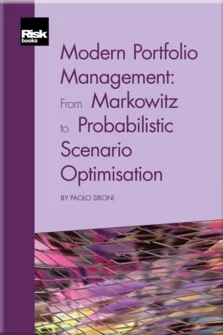
Modern Portfolio Management
First published:
ISBN: 9781782722045
If you are a Risk.net subscriber you are entitled to 20% off your Risk books purchases. Please email enquiries@riskbooks.com for more information.
As part of your Risk.net subscription you are entitled to 20% off all of your Risk Books purchases. If you would like to place an order please email enquiries@riskbooks.com
The Probability Measure
The Probability Measure
Foreword
Introduction
Beyond Modern Portfolio Theory
A Modern Risk Management Perspective
The Probability Measure
Real Securities and Reinvestment Strategies: Fixed-Income and Inflation-Linked Securities and Structured Products
Derivation and Modelling of Risk–Return Time Profiles
À la Markowitz: A Tale of Simple Worlds
The Black–Litterman Approach: A Tale of Subjective Views
Probabilistic Scenario Optimisation
Case Studies: Mean–Variance and Black–Litterman
Case Studies: Probabilistic Scenario Optimisation
A poker player may believe that a deck of cards is well shuffled. Yet he may not know all the implications of this belief. He is not likely to know, offhand, the probability of beating 3 aces and 2 jacks; or of beating 4 eights and a king if deuces are wild. It is usually not polite or convenient to employ a computing machine to calculate probabilities during the course of a poker game. In portfolio selection, however, the stakes are higher and decisions should be made on the basis of thorough analysis.
Markowitz (1959)
In this chapter we investigate the probability measure: a priori and a posteriori probability, the probability distribution function, goal-based probability and the analysis of ex post and ex ante performance.
INTRODUCTION
Risk-based portfolio management requires estimation of the probability density function of a multitude of risk factors to model the potential dynamics of asset prices and inform investment decision-making within a consistent risk management framework. Classical approaches to portfolio choice have relied upon the measurement of specific moments of these distributions or tail loss estimates in order to formulate the objective function
Copyright Infopro Digital Limited. All rights reserved.
As outlined in our terms and conditions, https://www.infopro-digital.com/terms-and-conditions/subscriptions/ (point 2.4), printing is limited to a single copy.
If you would like to purchase additional rights please email info@risk.net
Copyright Infopro Digital Limited. All rights reserved.
You may share this content using our article tools. As outlined in our terms and conditions, https://www.infopro-digital.com/terms-and-conditions/subscriptions/ (clause 2.4), an Authorised User may only make one copy of the materials for their own personal use. You must also comply with the restrictions in clause 2.5.
If you would like to purchase additional rights please email info@risk.net