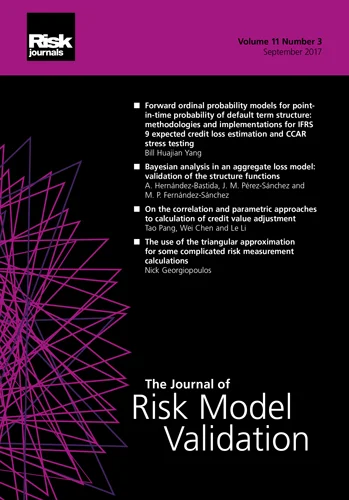
Journal of Risk Model Validation
ISSN:
1753-9587 (online)
Editor-in-chief: Steve Satchell
About this journal
As monetary institutions rely greatly on economic and financial models for a wide array of applications, model validation has become progressively inventive within the field of risk. The Journal of Risk Model Validation focuses on the implementation and validation of risk models, and aims to provide a greater understanding of key issues including the empirical evaluation of existing models, pitfalls in model validation and the development of new methods. We also publish papers on back-testing. Our main field of application is in credit risk modelling but we are happy to consider any issues of risk model validation for any financial asset class.
The Journal of Risk Model Validation considers submissions in the form of research papers on topics including, but not limited to:
- Empirical model evaluation studies
- Backtesting studies
- Stress-testing studies
- New methods of model validation/backtesting/stress-testing
- Best practices in model development, deployment, production and maintenance
- Pitfalls in model validation techniques (all types of risk, forecasting, pricing and rating)
Abstracting and Indexing: Scopus; Web of Science - Social Science Index; EconLit; Econbiz; and Cabell’s Directory
Journal Metrics:
Journal Impact Factor: 0.6
5-Year Impact Factor: 0.4
CiteScore: 1.1
Latest papers
Research on equity release mortgage risk diversification with financial innovation: reinsurance usage
This paper examines the risk diversification of ERMs via the reinsurance strategy.
Dynamic credit score modeling with short-term and long-term memories: the case of Freddie Mac’s database
This paper investigates the two mechanisms of memory, short-term memory and long-term memory, in the context of credit risk assessment.
Value-at-risk time scaling: a Monte Carlo approach
This paper discusses a VaR time-scaling approach based on fitting a distribution function so as to apply a Monte Carlo simulation to determine long-term VaR.
An application of sensitivity analysis to hedge funds
This paper investigates a sample of 142 live hedge funds via a DEA sensitivity analysis using a super-efficiency model.
Banks’ expected equity-to-asset ratio bounds under foreign exchange risk
This paper develops optimal bounds of the expectation equity-to-asset ratio.
Liquidity stress testing: a model for a portfolio of credit lines
This paper demonstrates how cash outflows due to credit lines can be modeled in a liquidity stress test.
Downside risk measure performance in the presence of breaks in volatility
This paper proposes a loss function-based framework for the comparative measurement of the sensitivity of quantile downside risk measures to breaks in volatility or distribution.
A mean-reverting scenario design model to create lifetime forecasts and volatility assessments for retail loans
The authors of this paper develop a modeling framework that can incorporate mean-reverting scenarios into any scenario-based forecasting model.
AERB: developing AIRB PIT–TTC PD models using external ratings
In this paper, the authors show how one can use a certain class of models for modeling portfolios such as large corporates, banks and insurance companies.
Risk model validation for BRICS countries: a value-at-risk, expected shortfall and extreme value theory approach
The authors of this paper employ value-at-risk (VaR) and expected shortfall (ES) as risk measures to assess the competency of several volatility models, based on the stock indexes of the BRICS countries (Brazil, Russia, India, China and South Africa)…
Stress testing and model validation: application of the Bayesian approach to a credit risk portfolio
The authors of this paper develop a Bayesian-based credit risk stress-testing methodology.
Loss given default modeling: an application to data from a Polish bank
This paper compares two methods of estimating LGD: a beta regression model and a multinomial logit (MNL) model.
Comprehensive Capital Analysis and Review stress tests: is regression the only tool for loss projection?
The authors of this paper present a cross-sectional stress test analysis of major US banks.
Commodity value-at-risk modeling: comparing RiskMetrics, historic simulation and quantile regression
The authors of this paper investigate the risk modeling of commodities. They note that return distributions differ widely across different commodities, both in terms of tail fatness and skewness.
Stress testing and modeling of rating migration under the Vasicek model framework: empirical approaches and technical implementation
This paper is concerned with stress testing the Vasicek model by extending the correlation structure for nondefault ratings. Two models are proposed.
Backtesting Solvency II value-at-risk models using a rolling horizon
The author of this paper performs an analysis on a review of the equity stress parameter for Dutch pension funds.
Biased benchmarks
The authors of this paper contend that recent evidence indicates that benchmarks have, over the last eleven years, exaggerated default risk for nonfinancial corporate entities.
The effect of introducing economic variables into credit scorecards: an example from invoice discounting
Country risk index and sovereign ratings: do they foresee financial crises?
The role of the loss function in value-at-risk comparisons