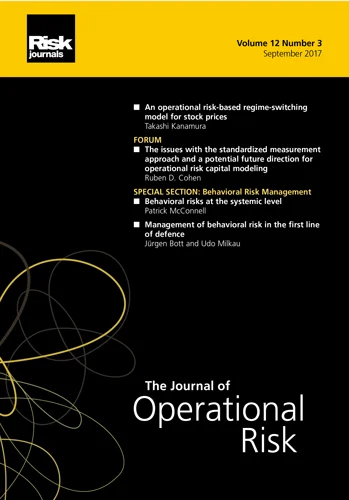
Journal of Operational Risk
ISSN:
1755-2710 (online)
Editor-in-chief: Marcelo Cruz
About this journal
Of the main areas of risk management, operational risk has the shortest history, with the industry beginning to give it serious consideration only 25 years ago. In that time, the industry has made great strides in both the definition and quantification of operational risk. The Journal of Operational Risk has been publishing papers at the forefront of this development since its inception.
On the quantification side, significant progress has been made, with major banks disclosing their operational risk exposures on a yearly basis. For many financial institutions their operational risk exposure is higher than that of market and credit risks. One large operational risk event can be lethal to a financial firm. Operational risk is thus a key concern for the industry as well as for the regulators that supervise financial institutions.
On the definition side, the industry has recently introduced the concept of “Non-Financial Risk” encompassing not just the early definition of operational risk but other risks like strategic, people, cyber, IT, etc. A broader view of operational risk would also consider Enterprise Risk Management, Cyber Risk Management, Information Technology Risks, Data Quality Risks amongst others. The introduction of new technologies like machine learning, artificial intelligence alongside new quantification ideas makes operational risk an intriguing risk domain with a green field for development and implementation of new ideas and theories.
With that in mind, The Journal of Operational Risk welcomes papers on non-financial risks as well as topics including, but not limited to, the following.
- The modeling and management of operational risk;
- Recent advances in techniques used to model operational risk, e.g., copulas, correlation, aggregate loss distributions, Bayesian methods and extreme value theory;
- The pricing and hedging of operational risk and/or any risk transfer techniques;
- Data modeling external loss data, business control factors and scenario analysis;
- Models used to aggregate different types of data;
- Causal models that link key risk indicators and macroeconomic factors to operational losses;
- Regulatory issues, such as Basel II or any other local regulatory issue;
- Enterprise risk management;
- Cyber risk management;
- IT risk management (how systems errors/fails impact an organization and change their risk profile);
- Big data applications to non-financial risk;
- Artificial intelligence and machine learning applications to risk management;
- Qualitative analysis of non-financial risks.
Journal Metrics:
Journal Impact Factor: 0.8
5-Year Impact Factor: 0.7
CiteScore: 1.3
Latest papers
How to turn uncertainties of operational risk capital into opportunities from a risk management perspective
Going beyond the regulatory requirements to operational risk measurement, the authors of this paper aim to provide relevant business applications to a bank.
Operational risk: impact assessment of the revised standardized approach on Indian banks
This paper focuses on a comparison of the capital for Indian banks as required by the current regime for capital charge calculation, versus the possible revised Standardised Approach.
Operational loss with correlated frequency and severity: an analytical approach
To enable autocorrelation in the frequency distribution, this paper proposes a significant generalization of the LDA model that involves treating operational risk as a Lévy jump-diffusion.
Evaluating operational risk by an inhomogeneous counting process based on Panjer recursion
This paper proposes a new approach for determining OpVaR using an inhomogeneous counting process based on Panjer recursion as the frequency distribution.
A simulation comparison of quantile approximation techniques for compound distributions popular in operational risk
The objective of this paper is to compare numerical approximation techniques in terms of their practical usefulness and potential applicability in an operational risk context.
A maximum entropy approach to the loss data aggregation problem
This paper examines and compares alternative ways of solving the problem of determining the density of aggregate losses.
Bank fraud and the macroeconomy
This paper empirically tests for correlations between fraud and the macroeconomy.
Modeling operational risk capital: the inconvenient truth
This paper shows that it is an "inconvenient truth" that the largest losses by banks are not firm specific.
Random matrix theory applied to correlations in operational risk
This paper focuses on the distribution of correlations among aggregate operational risk losses.
Application of the convolution operator for scenario integration with loss data in operational risk modeling
This paper addresses the uncertainty in scenario analysis and produces a combined loss distribution.
A comparison of alternative mixing models for external data in operational risk
This paper studies alternative mixing models for external data for a particular risk class.
Truncated lognormals as a power-law mimic in operational risk
This paper makes use of the power-law mimicry properties of the truncated lognormal distribution and shows how they fit operational risk data considerably well.
Outsourcing risk: a separate operational risk category?
This paper identifies three steps in sourcing risk.
Mitigating rogue-trading behavior by means of appropriate, effective operational risk management
This paper discusses the violation of applicable firm guidelines by individuals employed by a bank or financial institution and suggests specific metrics to identify and prevent such behaviour.
A weighted likelihood estimator for operational risk data: improving the accuracy of capital estimates by robustifying maximum likelihood estimates
This paper proposes the use of a robust generalization of MLEs for the modeling of operational loss data.
Monitoring IT operational risks across US capital markets
This paper suggests an approach for assessing IT risk through an incident-based method for monitoring operational IT risk across an extended enterprise based on the ISACA Risk IT framework.
Bayesian operational risk models
This paper proposes a methodology to frame risk self-assessment data into suitable prior distributions that can produce posterior distributions from which accurate operational risk measures.
A simple, transparent and rational weighting approach to combining different operational risk data sources
The authors propose a generic weighting function based on a nonparametric approach that can be used to weight the different distributions.
Approximations of value-at-risk as an extreme quantile of a random sum of heavy-tailed random variables
The authors of this paper study the approximation of extreme quantiles of random sums of heavy-tailed random variables. More specifically, sub-exponential random variables.
An assessment of the efficiency of operational risk management in Taiwan’s banking industry: an application of the stochastic frontier approach