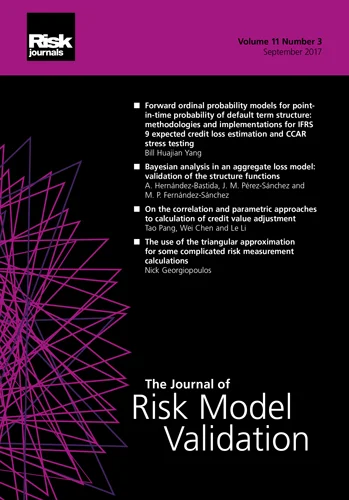
Journal of Risk Model Validation
ISSN:
1753-9587 (online)
Editor-in-chief: Steve Satchell

Need to know
- The Fundamental Review of the Trading Book encourages financial institutions to shift from value-at-risk to the expected shortfall risk measure when measuring market risk capital. Backtesting of ES models is usually less intuitive and requires more sophisticated procedures than VaR model backtesting.
- The purpose of this article is to examine the possibility of expressing the expected shortfall in a form similar to VaR (quantile form) and, consequently, backtesting it with the equivalent methods as VaR models.
- The work concludes that such backtesting is possible either in its pure form (constant quantile case) or with an adjustment (varying quantile case). Both approaches are illustrated on real-world financial data.
Abstract
The Fundamental Review of the Trading Book encourages financial institutions to shift from the value-at-risk (VaR) to the expected shortfall (ES) risk measure when measuring market risk capital. This paper examines the application of exceedance-based validation (or “backtesting”) methods, commonly used for VaR model validation, to the validation of ES models. The examined approach includes finding the quantile value corresponding to the ES for four different estimation methods: an analytical delta-normal approach, an analytical generalized Pareto distribution-based approach, numerical Monte Carlo simulation and nonparametric historical simulation. The paper also investigates the stability of this quantile and proposes an adjustment to the traditional backtesting approaches that helps to accommodate an unstable quantile. The application of the approach is illustrated using real-world Baltic equity index (OMXBBGI) returns data for three different confidence levels: 90%, 95% and 97.5%. Our findings show that the direct application of exceedance-based methods to the validation of ES models is possible, even in the case of an unstable ES quantile.
Copyright Infopro Digital Limited. All rights reserved.
As outlined in our terms and conditions, https://www.infopro-digital.com/terms-and-conditions/subscriptions/ (point 2.4), printing is limited to a single copy.
If you would like to purchase additional rights please email info@risk.net
Copyright Infopro Digital Limited. All rights reserved.
You may share this content using our article tools. As outlined in our terms and conditions, https://www.infopro-digital.com/terms-and-conditions/subscriptions/ (clause 2.4), an Authorised User may only make one copy of the materials for their own personal use. You must also comply with the restrictions in clause 2.5.
If you would like to purchase additional rights please email info@risk.net