Model Risk and Uncertainty in the Financial World
First published:
ISBN: 978-1-78272-420-9
If you are a Risk.net subscriber you are entitled to 20% off your Risk books purchases. Please email enquiries@riskbooks.com for more information.
As part of your Risk.net subscription you are entitled to 20% off all of your Risk Books purchases. If you would like to place an order please email enquiries@riskbooks.com
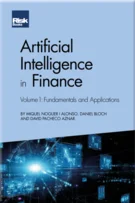
Artificial intelligence in finance: a synthesis of human and machine
Foreword
Preface
Acknowledgements
The evolution of models
The foundations of risk and uncertainty
Uncertainty: a taxonomy
Model risk and uncertainty: a survey of the institutional landscape
Model specification risk and uncertainty
Model operation risk and uncertainty
Data, models and their purpose
Artificial intelligence in finance: a synthesis of human and machine
A deeper dive into machine learning methods: their opportunities, limitations, risks and uncertainties
Measurement of risk and estimation of uncertainty in prediction models
Using models under risk and uncertainty
When models fail
Epilogue: models and the future
Computers will overtake humans with AI within the next 100 years. When that happens, we need to make sure the computers have goals aligned with ours.
Stephen Hawking (speaking at Zeitgeist 2015)
8.1 INTRODUCTION
The advent of the idea of “artificial intelligence” (although not the term “AI” itself) in the popular zeitgeist, dates back to Alan Turing’s influential paper in the philosophy journal Mind, where he proposed a response to the question “Can machines think?” (Turing 1950). Aware of the difficulties involved in defining terms such as “machine” and “think”, he proposed a test (which has come to be known as the Turing test), which transformed the question to “Can a digital computer (or more generally, discrete state machines) convince a human interrogator that it is human?”. Turing motivated his test with a game that he called the “imitation game”. The game is played with three players, A (male), B (female) and C (interrogator of any gender). The object is for C to determine who is male and who is female with a series of questions. The Turing test proposes that if a digital machine were to replace either A or B, and a human interrogator C makes the wrong decision about as often
Copyright Infopro Digital Limited. All rights reserved.
As outlined in our terms and conditions, https://www.infopro-digital.com/terms-and-conditions/subscriptions/ (point 2.4), printing is limited to a single copy.
If you would like to purchase additional rights please email info@risk.net
Copyright Infopro Digital Limited. All rights reserved.
You may share this content using our article tools. As outlined in our terms and conditions, https://www.infopro-digital.com/terms-and-conditions/subscriptions/ (clause 2.4), an Authorised User may only make one copy of the materials for their own personal use. You must also comply with the restrictions in clause 2.5.
If you would like to purchase additional rights please email info@risk.net