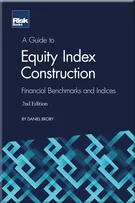
A Guide to Equity Index Construction (2nd Edition)
First published:
ISBN: 9781782724513
If you are a Risk.net subscriber you are entitled to 20% off your Risk books purchases. Please email enquiries@riskbooks.com for more information.
As part of your Risk.net subscription you are entitled to 20% off all of your Risk Books purchases. If you would like to place an order please email enquiries@riskbooks.com
Indexation and exchange-traded funds
Preface
Acknowledgements
Introduction
Which benchmark?
Modern portfolio theory and the benchmark index
Sampling and selection
Construction method
Making the index investable
Collection and processing of data
Servicing and maintenance
How to handle industries
How to handle countries and currencies
Factor indices and smart beta
Innovative indices
The commercial indices
Indexation and exchange-traded funds
Bespoke “custom-made” indices
Tying it all together
Appendix: The GICS methodology
Bibliography
Disclaimer
INTRODUCTION
“[We need to know] the difference between what the index is assumed to replicate and what it actually replicates.”
—Leibenstein (1966)
In this chapter, we will explore the fundamentals of indexation, the historical context of index tracking and the different methods used to achieve index replication. The focus will be on ETFs, defined as follows.
Definition 14.1. Exchange-traded funds ETFs are pooled investment vehicles with shares that can be bought or sold throughout the day on an exchange at a market-determined price. Like a mutual fund, an ETF offers investors a proportionate share in a pool of stocks, bonds and other assets.
We will also examine the costs associated with indexation and how fund managers strive to minimise tracking error to create efficient and effective index funds.
As of the end of September 2023, Lipper reports that assets under management in the global ETF industry reached USD9,951.4 billion. Predominantly, these assets, totalling USD7,606.2 billion, were invested in equity ETFs. Following this category, bond ETFs held USD1,929.6 billion, commodities ETFs amounted to USD185.1 billion, alternatives ETFs stood at USD76.5 billion, “other” ETFs
Copyright Infopro Digital Limited. All rights reserved.
As outlined in our terms and conditions, https://www.infopro-digital.com/terms-and-conditions/subscriptions/ (point 2.4), printing is limited to a single copy.
If you would like to purchase additional rights please email info@risk.net
Copyright Infopro Digital Limited. All rights reserved.
You may share this content using our article tools. As outlined in our terms and conditions, https://www.infopro-digital.com/terms-and-conditions/subscriptions/ (clause 2.4), an Authorised User may only make one copy of the materials for their own personal use. You must also comply with the restrictions in clause 2.5.
If you would like to purchase additional rights please email info@risk.net