
For collateral, can TINA become TIA?
US Treasuries’ dominance as collateral in repo and derivatives is no longer set in stone, argues economist
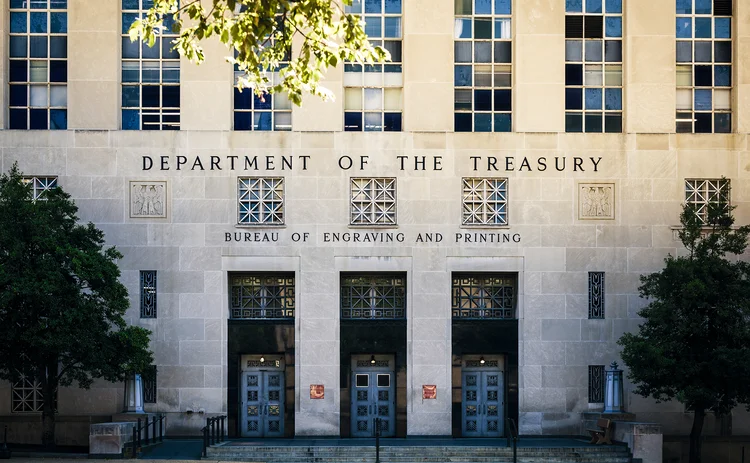

US Treasuries are the collateral that lubricates the world’s financial market plumbing. The bonds underpin repo markets, prime brokerage, securities lending and derivatives trading.
The market’s size, depth and liquidity give it the status of TINA: There Is No Alternative. But the US Treasury debt pile is growing and the plumbing is starting to creak. As alternative sources of collateral begin to emerge, can TINA become TIA?
Ten years ago, despite capital controls, the Chinese renminbi joined the US dollar, euro, sterling and yen in the privileged basket of currencies known as the special drawing rights of the IMF. The currencies qualify as a stable asset in countries’ international reserves. And last year, swap clearing giant LCH began accepting Chinese government bonds denominated in US dollars and euros as collateral. Discussions are under way to add Chinese renminbi govvies to the list.
But China has a long way to go to threaten the dominance of US Treasuries as a collateral source. Its neighbour, Japan, has the second largest amount of outstanding government debt, yet the listed bond market is moribund. Japanese government bonds are kept within Japan, tucked in prefectures or for regulatory requirements. Some days there are no JGB trades on JPX Group – which includes the Tokyo and Osaka exchanges – or there is zero demand for the Bank of Japan’s securities lending facility.
At $30 trillion, the US Treasuries market is far larger than any other market. But this makes it increasingly difficult to ‘complete markets’ in all US Treasuries products. For some dealers, it is uneconomical to use up valuable balance sheet to trade Treasuries with wafer-thin margins.
The market is likely to get even larger, given the debt issuance in the pipeline under the US administration’s One Big Beautiful Bill. The financial plumbing that straddles US Treasuries in futures, derivatives and rehypothecation of collateral is already clogged as dealer balance sheets are constrained.
In the likelihood of no new pipes (ie, relaxing regulation for dealer banks), there are two possible outcomes. Digital advances may lead to a rewiring of collateral markets, with stablecoins and tokenised deposits leading to T+0 settlement time and higher collateral and money velocities.
Or, more likely, the Fed will continue to create more bilateral ‘cash pipes’, such as money market funds’ (MMFs) access to the Fed’s reverse repo programme. This action will bifurcate and rust the market plumbing.
At one end of the chain is the supplier of money: the rich household and corporate wealth pool that invests in MMFs. At the other end, after a couple of loops for transformation, and some haircuts and subordination for extra capital, lies the promise to pay by the borrower, namely the hedge fund or mortgage household.
Direct deposits at the Fed short-circuit this collateral chain, causing the plumbing to rust. The household and corporate wealth pool is better off: it gets a deposit alternative that is superior to anything available. The borrower pool is worse off, as money will directly go to the Fed and won’t be transformed into any lending to that pool.
Although geopolitical shifts and fiscal profligacy in the US are already leading to a search for TIA, the world still needs a stable collateral anchor. Demand for alternative reserve assets is growing, especially among the Bric countries and other emerging markets. However, the supply is limited. Some markets, such as Germany or Switzerland, provide good collateral, but their bonds are only in the $1–2 trillion range, or less than one-fifteenth the size of US Treasuries.
This may be changing, with the eurozone contemplating issuing sizeably more joint-euro debt. China is also making advances in prime brokerage markets in some Asian circles; for example, the country’s repo markets are widening access and local derivatives contracts are converging to international standards.
Neither is the pipework limited to US institutions alone. For example, Barclays is a sizeable force in the non-US banking space and recycles as much collateral as JP Morgan. BNP Paribas, HSBC, Nomura and Societe Generale are also not trivial players in the pledged collateral market. If the European Union issues more debt jointly under the eurozone name, and Chinese renminbi collateral is acceptable at LCH in the not-too-distant future, plumbing will follow.
Even if the status quo biases the US banks to peddle only US Treasuries, the TIA theme may already be emerging in a fractured geopolitical world.
Manmohan Singh is editor-in-chief of the Journal of Financial Market Infrastructures and was formerly with the IMF
Editing by Alex Krohn
Only users who have a paid subscription or are part of a corporate subscription are able to print or copy content.
To access these options, along with all other subscription benefits, please contact info@risk.net or view our subscription options here: http://subscriptions.risk.net/subscribe
You are currently unable to print this content. Please contact info@risk.net to find out more.
You are currently unable to copy this content. Please contact info@risk.net to find out more.
Copyright Infopro Digital Limited. All rights reserved.
As outlined in our terms and conditions, https://www.infopro-digital.com/terms-and-conditions/subscriptions/ (point 2.4), printing is limited to a single copy.
If you would like to purchase additional rights please email info@risk.net
Copyright Infopro Digital Limited. All rights reserved.
You may share this content using our article tools. As outlined in our terms and conditions, https://www.infopro-digital.com/terms-and-conditions/subscriptions/ (clause 2.4), an Authorised User may only make one copy of the materials for their own personal use. You must also comply with the restrictions in clause 2.5.
If you would like to purchase additional rights please email info@risk.net
More on Comment
Swiss franc loan losses are a grey rhino for EU consumer finance
Impact on Polish banks exposed a blind spot on modelling legal risk that has wider implications, says mBank CRO Marek Lusztyn

Op risk data: EFG takes a bath for two decades of money laundering
Also: Deepfake voice clone cons Intesa division; key couple of cryptocurrency hacks. Data by ORX News
From Navier-Stokes to manuscripts by the kilo: AI’s impact on quant research
As AI produces results in bulk, finance needs trusted ways to assess provenance, reliability and significance

Continuous verification holds key to keeping AI on track
Decision-by-decision testing will help users trust AI judgement calls

What happens when AI gets good at your risk management job?
Risk executive Alex Golbin asks how to build a valuable career in risk as agentic AI takes on more analysis

Repricing inflation risk in choppy energy markets
Barclays’ Samy Ben Aoun outlines a method for modelling the sensitivity of inflation swaps to energy shocks

Op risk data: KKR crushes antitrust fine record over pre-merger filing fails
Also: Dealers pay up for Mexican bond-rigging scandal; missing AML checks at UBS. Data by ORX News

Tokenisation: a load of old bull for London’s financial markets?
Focusing on tech in context of digital transformation risks repeating 1980s Taurus debacle
