Asian insurers abandoning liability matching in the hunt for yield
Ultra-low rates forcing companies to shift focus from asset-liability matching

Low interest rates are forcing insurers in Asia to consider abandoning asset-liability matching, despite government efforts to increase the supply of long-dated instruments.
Duration matching has traditionally been a challenge for insurers in Asia because of the limited supply of long-duration government bonds, particularly those in Taiwan and South Korea.
But the low yield environment is putting
Only users who have a paid subscription or are part of a corporate subscription are able to print or copy content.
To access these options, along with all other subscription benefits, please contact info@risk.net or view our subscription options here: http://subscriptions.risk.net/subscribe
You are currently unable to print this content. Please contact info@risk.net to find out more.
You are currently unable to copy this content. Please contact info@risk.net to find out more.
Copyright Infopro Digital Limited. All rights reserved.
As outlined in our terms and conditions, https://www.infopro-digital.com/terms-and-conditions/subscriptions/ (point 2.4), printing is limited to a single copy.
If you would like to purchase additional rights please email info@risk.net
Copyright Infopro Digital Limited. All rights reserved.
You may share this content using our article tools. As outlined in our terms and conditions, https://www.infopro-digital.com/terms-and-conditions/subscriptions/ (clause 2.4), an Authorised User may only make one copy of the materials for their own personal use. You must also comply with the restrictions in clause 2.5.
If you would like to purchase additional rights please email info@risk.net
More on Asset liability management
The future of ALM: the rise of risk-adjusted business planning
Where financial institutions can build a foundation for risk-adjusted business planning, aided by the ALM systems of the future

ALM technology systems 2023: market update and vendor landscape
Chartis' 2023 ALM research report returns to the key themes highlighted in the 2021 report. This update re-evaluates the complex ALM framework, which broadly comprises distinct segments that include funds transfer pricing, liquidity risk management and…

Incorporating climate risk into ALM frameworks at banks
In this webinar convened by Risk.net in collaboration with SS&C Algorithmics, experts discuss the challenges and benefits of incorporating climate risk into asset-liability management frameworks at banks

ERM reboot: how leading insurers are turning risk decisioning into strategic advantage
An expert discussion exploring how leading insurers are adapting ERM systems in support of a wider range of opportunities, helping to avoid losses, navigate unstable markets and maintain a strong reputation

Incorporating climate risk into ALM frameworks for banks
Banks are coming under increasing regulatory pressure to incorporate climate risk into their risk management frameworks. An emerging focus is incorporating climate risk into the asset-liability management (ALM) function. This webinar explores this new…

ALM and liquidity risk reporting greatly enhanced by big data applications
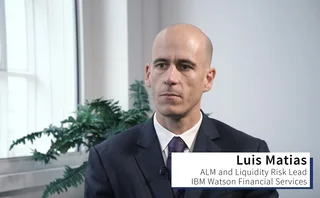
Sponsored video: Luis Mataias, IBM Watson Financial Services
Leading the way in the risk management (r)evolution
Sponsored feature: Prometeia
Insurers must perform balancing act
Winners' Circle: RBS