Expectiles behave as expected
Expectiles have been mooted as an alternative risk measure to value-at-risk (VAR) and expected shortfall. Here, Richard Martin derives their saddlepoint approximation and shows that their risk contributions are essentially the same as those of expected shortfall
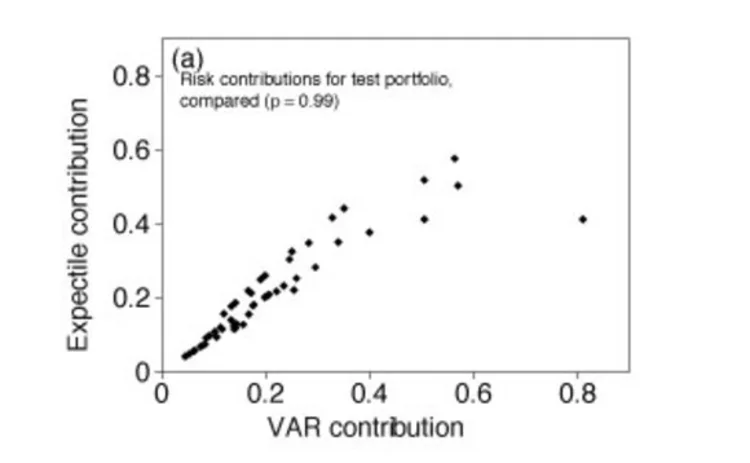
A recent criticism of the expected shortfall risk measure is that it is not elicitable (Gneiting 2011). This means that one cannot, in a backtesting procedure, make point forecasts of it and check whether the forecasting procedureworks (see Cont, Deguest and Scandolo (2010) for a fuller discussion of this concept). The discussion of this is still at an early stage, and the author is not convinced
Only users who have a paid subscription or are part of a corporate subscription are able to print or copy content.
To access these options, along with all other subscription benefits, please contact info@risk.net or view our subscription options here: http://subscriptions.risk.net/subscribe
You are currently unable to print this content. Please contact info@risk.net to find out more.
You are currently unable to copy this content. Please contact info@risk.net to find out more.
Copyright Infopro Digital Limited. All rights reserved.
As outlined in our terms and conditions, https://www.infopro-digital.com/terms-and-conditions/subscriptions/ (point 2.4), printing is limited to a single copy.
If you would like to purchase additional rights please email info@risk.net
Copyright Infopro Digital Limited. All rights reserved.
You may share this content using our article tools. As outlined in our terms and conditions, https://www.infopro-digital.com/terms-and-conditions/subscriptions/ (clause 2.4), an Authorised User may only make one copy of the materials for their own personal use. You must also comply with the restrictions in clause 2.5.
If you would like to purchase additional rights please email info@risk.net
More on Risk management
Swiss franc loan losses are a grey rhino for EU consumer finance
Impact on Polish banks exposed a blind spot on modelling legal risk that has wider implications, says mBank CRO Marek Lusztyn

CROs urged to use ‘creative’ stress tests for interconnected risks
Risk Live Asia: AI, cyber security and geopolitics mean faster shock transmission across risk types

Trading platforms evolve for a cross-asset market
As trading becomes increasingly cross-asset, platforms are evolving to deliver consistent workflows, connectivity, intelligence and end-to-end execution efficiency

Industry pushes EU exchanges to solve equity post-trade frictions
Deutsche Bank, Goldman Sachs and JP Morgan join calls for mandatory cash CCP interoperability

US Treasury clearing: competition, choice and readiness move to the fore
US Treasury clearing mandates and market reforms are reshaping clearing models, risk transfer and market infrastructure ahead of key implementation milestones

Barclays built a system to spot AI agents that might go rogue
Research setup ‘reads the mind’ of LLM-based agents and flags if they’re about to do something risky

Op risk data: EFG takes a bath for two decades of money laundering
Also: Deepfake voice clone cons Intesa division; key couple of cryptocurrency hacks. Data by ORX News
Managing risk to accelerate agentic AI value creation
Banks can accelerate agentic AI adoption by aligning each use case’s risks, controls and capabilities, enabling safe, accountable and value-driven deployment