FSA closes GLG insider trading case
The UK’s Financial Services Authority today said it has fined hedge fund manager GLG Partners (GLG) and Mr Philippe Jabre, a former managing director of the firm, £750,000 each for market abuse, in a ruling that closes the high-profile insider trading case.
Jabre last week withdrew his appeal against the record fine for market abuse against an individual. His lawyers had questioned if the FSA’s Financial Services and Markets Tribunal had jurisdiction in Japan, where the trades took place.
Jabre was 'wall crossed' by Goldman Sachs International as part of the pre-marketing of a new issue of convertible preference shares in Sumitomo Mitsui Financial Group (SMFG) in February 2003.
The FSA said he was given confidential information and agreed to be restricted from dealing SMFG securities until the issue was announced. However, Jabre breached this restriction by short-selling around $16 million of SMFG ordinary shares in Tokyo, the FSA said. When the new issue was announced, Jabre made a substantial profit for the GLG Market Neutral Fund (see: FSA slaps £750,000 fine on GLG and its former trader).
“Jabre traded on information he had received as a result of the position he enjoyed as a leading hedge fund manager," said Margaret Cole, director of enforcement at the FSA. "The stability and fair operation of the markets through legitimate pre-marketing activities is jeopardised if those who are wall-crossed do not respect the restrictions imposed on them. GLG is also responsible for Jabre's market abuse. Firms are accountable for the behaviour of their employees, particularly if they are at a senior level.”
Only users who have a paid subscription or are part of a corporate subscription are able to print or copy content.
To access these options, along with all other subscription benefits, please contact info@risk.net or view our subscription options here: http://subscriptions.risk.net/subscribe
You are currently unable to print this content. Please contact info@risk.net to find out more.
You are currently unable to copy this content. Please contact info@risk.net to find out more.
Copyright Infopro Digital Limited. All rights reserved.
As outlined in our terms and conditions, https://www.infopro-digital.com/terms-and-conditions/subscriptions/ (point 2.4), printing is limited to a single copy.
If you would like to purchase additional rights please email info@risk.net
Copyright Infopro Digital Limited. All rights reserved.
You may share this content using our article tools. As outlined in our terms and conditions, https://www.infopro-digital.com/terms-and-conditions/subscriptions/ (clause 2.4), an Authorised User may only make one copy of the materials for their own personal use. You must also comply with the restrictions in clause 2.5.
If you would like to purchase additional rights please email info@risk.net
More on Regulation
FRTB revamp won’t restore models to past glory, risk managers say
US-inspired reform only expected to lead to small boost in adoption, with limited desks on IMA

Regulators must think bigger to tackle tech risks, says Hong Kong SFC
Leung warns AI adoption and recent cyber scares show new threats require global co-operation

Time to let some air out of the banking system?
Watchdogs worry about lowering standards, but policy-makers eye growth – they face a difficult dilemma

Competitiveness mandate for Esma faces uphill battle
European Parliament offers last chance to force Esma to take more nuanced approach

Europe expects FRTB to bite on XVA hedges
Risk Benchmarking: One-third of European dealers fear new market risk rules will have major effect on hedges

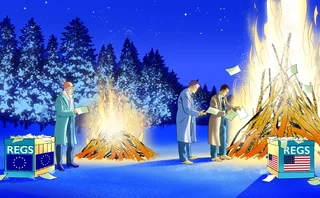
Burning ambition: will Europe join the US in setting fire to the rules?
As the US dismantles post-crisis regulations, some think Europe will follow in a bid to boost economic growth
Can US perpetual futures solve their identity crisis?
Market could fall under four different regulatory categories, with sharply diverging outcomes

Banks want AML data upgrade to complement US regulatory reform
FinCEN’s proposed overhaul sparks debate on whether it will lead to smarter or weaker supervision