Monthly swaps data review: Libor dominance challenged
There are more sources of over-the-counter derivatives data available today than at any point in the market’s history. In this series of monthly articles, Clarus Financial Technology’s Amir Khwaja looks for trends

The advent of new margining rules for non-cleared over-the-counter derivatives appears to have pushed volumes towards clearing houses for non-deliverable forwards (NDFs) and inflation swaps – with LCH being the main beneficiary. In contrast, swaptions continue to be traded bilaterally.
Elsewhere, February was the first month in which the notional volume of US dollar overnight indexed swaps (OIS) – in which the floating leg references the federal funds rate – surpassed volumes of traditional Libor-referencing interest rate swaps, apparently a response to the Federal Reserve’s rate-tightening agenda. Volumes of risk remain far higher in interest rate swaps, however, by virtue of the market’s longer average tenor.
The impact of margin
New margin requirements for non-cleared OTC derivatives trades had two main policy objectives – to reduce counterparty risk and to encourage the use of clearing houses by hiking the relative cost of trading bilaterally. Is the second of these objectives being met? The data for products with a historically low proportion of cleared volume suggests it is – but only for linear products.
Non-deliverable forwards
Non-deliverable forwards (NDFs) were initially expected to become subject to a clearing mandate in 2015, but regulators chose to pass. Clearing services for the product saw very low voluntary uptake.
So, the interesting question is whether the first phase of the non-cleared margin regime – which required big dealers to exchange initial margin from September 1, 2016 – has produced an increase in volumes.
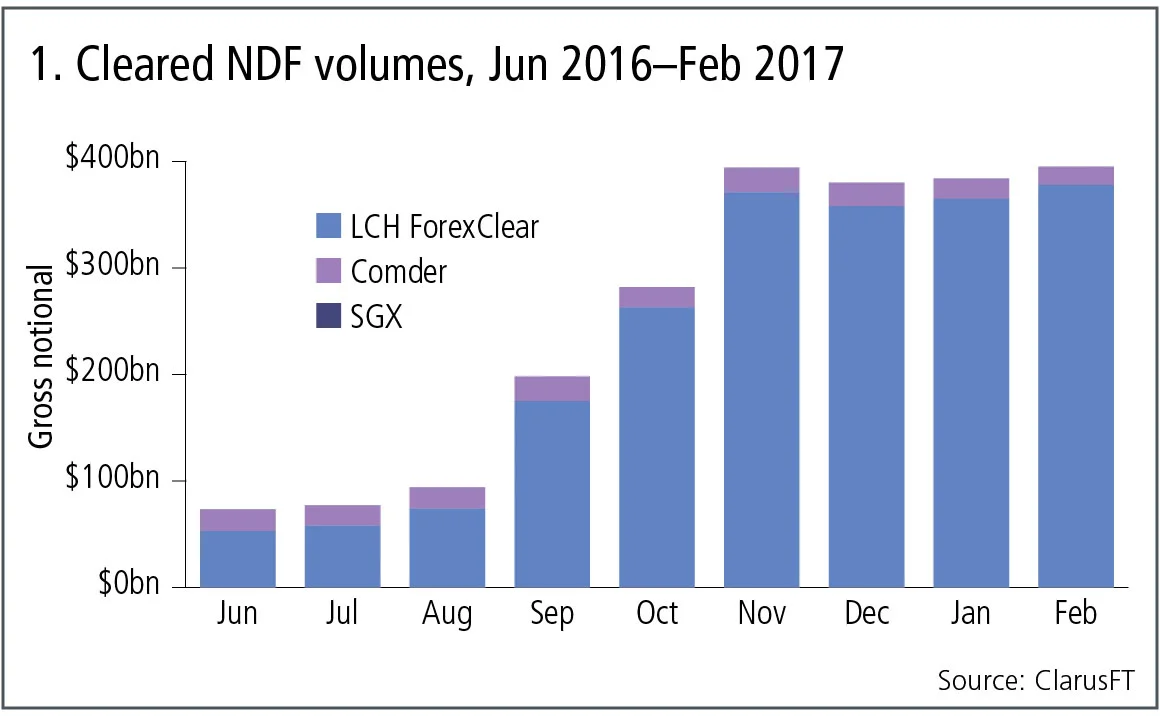
Figure 1 shows:
- LCH ForexClear has seen a sharp increase in monthly volumes from September 2016.
- Volumes jumped from around $60 billion a month prior to this date to $175 billion, $265 billion and $370 billion in the subsequent three months.
- Our research estimates 35% of global dealer-to-dealer NDF volume is now cleared.
- As clients are offered NDF clearing and as further margin deadlines pass, we expect this percentage to increase.
- Chile’s Comder shows a steady $20 billion of volume in Chilean peso trades each month.
- SGX is averaging just $40 million a month.
Inflation swaps
LCH SwapClear has offered clearing of inflation swaps since April 2015 and while volumes were low in 2015, the margin regime has had an impact.

Figure 2 shows:
- The advent of phase-one margining saw volumes leap from $15 billion in August 2016, to $85 billion in September.
- Recent months have hit record levels of around $115 billion.
- The split for euro, sterling and US dollar is roughly equal in the two most recent months.
Swaptions
CME Group has offered clearing of swaptions since April 2016, but there has been very little activity in this product and the September 2016 margin deadline has not been a catalyst.
This may be due to the fact CME interest rate swap volume is largely dominated by clients that are not yet in scope of the margin regime, while dealers that are subject to the rules have the bulk of their swap portfolios at LCH and so do not envisage any portfolio -margining -benefits.
It may also be the case that managing risk and default for the non-linear risks in swaptions portfolios is seen as unproven. Even the – arguably – more liquid and widely traded foreign exchange options market has not yet seen meaningful clearing activity, which might suggest the market needs time to come to terms with the concept.
Data from US swap execution facilities (Sefs) and swap data repositories (SDRs) gives us a sense of the size of the swaptions market for US persons.
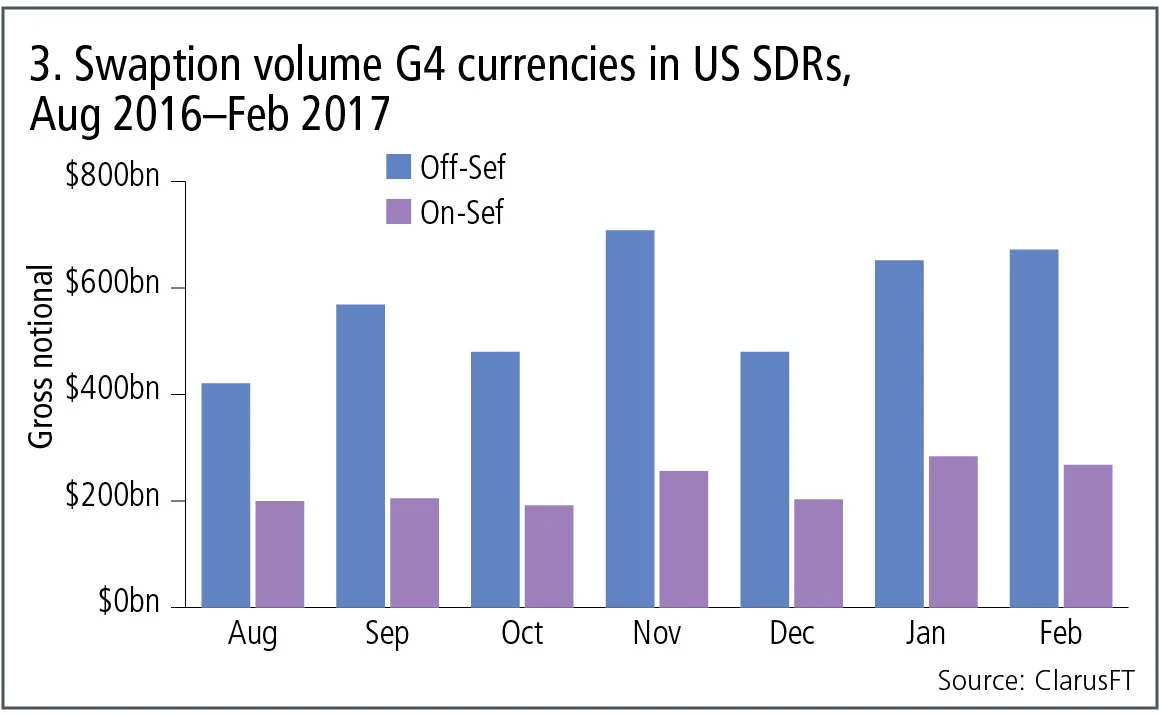
Figure 3 shows:
- $200 billion–$280 billion of monthly volume on Sef platforms.
- $400 billion–$700 billion monthly volume conducted off Sef.
These are significant numbers, suggesting the market would benefit from the ability to net multilaterally at a clearing house, rather than netting bilaterally with each counterparty. Only time will tell.
US dollar overnight indexed swaps
Another product that has seen significant changes in volume – for reasons unrelated to margining – is US dollar OIS, where the floating leg references the federal funds rate, rather than Libor.
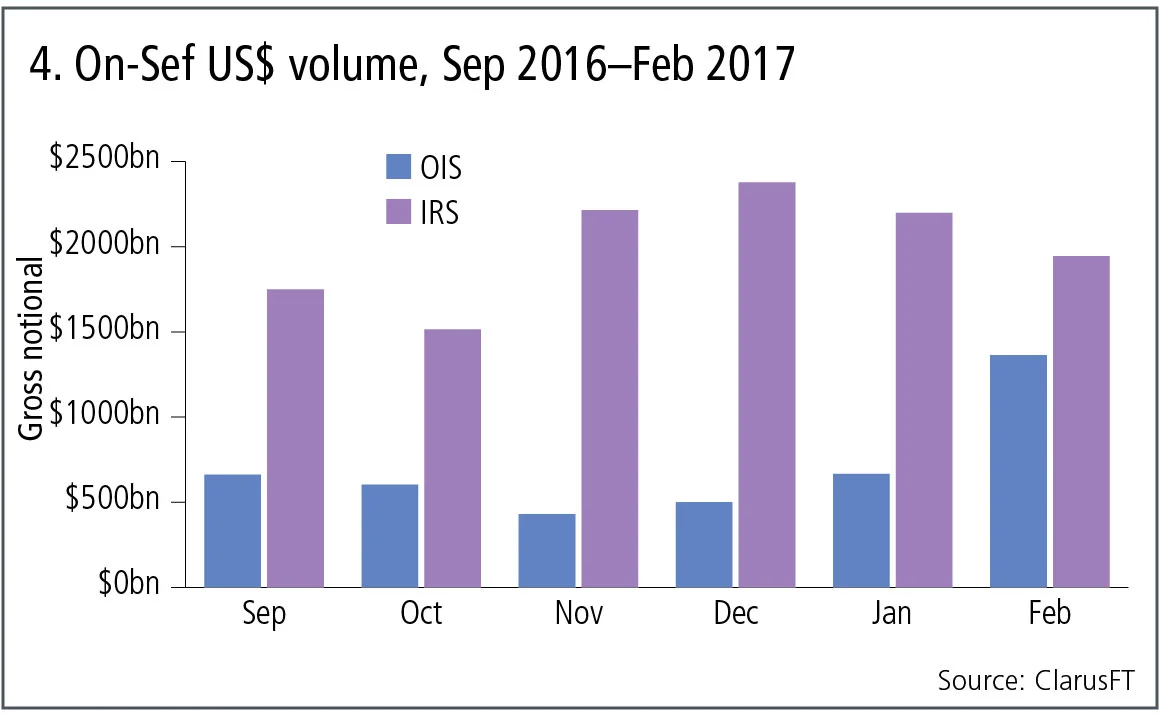
Figure 4 shows:
- Monthly on-Sef volumes of OIS and interest rate swaps.
- Interest rate swap monthly volume of between $1.5 trillion and $2.4 trillion (including Sef compression).
- OIS monthly volume of around $600 billion, increasing massively to $1.4 trillion in the most recent month.
- Such periodic jumps in US dollar OIS trading have occurred in prior months too and appear to reflect the increasing size and importance of the fed funds index as the Federal Reserve proceeds to raise interest rates.
- Feb 2017 OIS figures also include $164 billion of Sef compression at TrueEx, the first time we have seen such size in this product.
Turning to off-Sef activity and comparing OIS and interest rate swap volumes we see a different picture – with OIS notional volumes beating interest rate swaps. This is not a huge surprise, given the OIS product is not subject to the Sef-trading mandate, unlike vanilla interest rate swaps, but in tandem with the on-Sef volumes it illustrates an interesting trend.
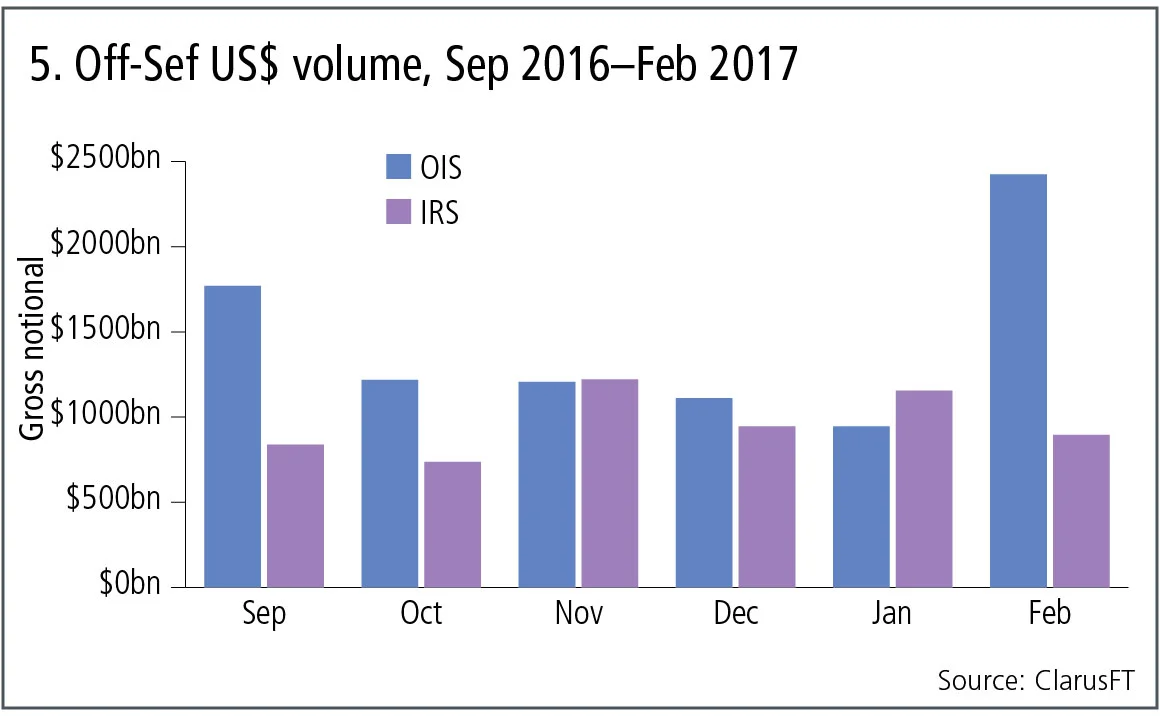
Figure 5 shows:
- Monthly off-Sef OIS volumes are higher than interest rate swaps in most months.
- The gap is significantly in September 2016 and February 2017.
- OIS volumes range from $1 trillion to $2.5 trillion.
- Interest rate swap volumes range from $0.7 trillion to $1.2 trillion.
Note all these figures are understated as SDR volumes are capped for large trade notionals and the true volume is likely to be at least 30% higher.
Adding the on- and off-Sef volumes, February 2017 is the first and only month in the record where US dollar OIS volumes have beaten interest rate swap volumes.
It’s important to note the average tenor of US dollar interest rate swaps is much longer than for OIS, so the per-basis point risk in the former will be much larger for the same notional. Our research shows that over the past 12 months, the average tenor for US dollar interest rate swaps was five-and-a-half years, compared to three months for US dollar OIS. Nevertheless, the data shows the relative risk traded in US dollar OIS versus US dollar interest rate swaps has increased from less than 5% in 2014 to 20% in February 2017.
It will be interesting to see whether this trend continues and if more varied and longer tenors start to trade more frequently in the OIS products, gradually eroding the dominance of Libor as the major index in the swap market.
コンテンツを印刷またはコピーできるのは、有料の購読契約を結んでいるユーザー、または法人購読契約の一員であるユーザーのみです。
これらのオプションやその他の購読特典を利用するには、info@risk.net にお問い合わせいただくか、こちらの購読オプションをご覧ください: http://subscriptions.risk.net/subscribe
現在、このコンテンツを印刷することはできません。詳しくはinfo@risk.netまでお問い合わせください。
現在、このコンテンツをコピーすることはできません。詳しくはinfo@risk.netまでお問い合わせください。
Copyright インフォプロ・デジタル・リミテッド.無断複写・転載を禁じます。
当社の利用規約、https://www.infopro-digital.com/terms-and-conditions/subscriptions/(ポイント2.4)に記載されているように、印刷は1部のみです。
追加の権利を購入したい場合は、info@risk.netまで電子メールでご連絡ください。
Copyright インフォプロ・デジタル・リミテッド.無断複写・転載を禁じます。
このコンテンツは、当社の記事ツールを使用して共有することができます。当社の利用規約、https://www.infopro-digital.com/terms-and-conditions/subscriptions/(第2.4項)に概説されているように、認定ユーザーは、個人的な使用のために資料のコピーを1部のみ作成することができます。また、2.5項の制限にも従わなければなりません。
追加権利の購入をご希望の場合は、info@risk.netまで電子メールでご連絡ください。
詳細はこちら 市場
Manuela Veloso on how banks can make their AI dreams reality
Former JP Morgan head of AI research says open-ended enquiry will unlock technology’s full potential

KOSPIとウォン相場の連動性が弱まる中、トレーダーたちは引き続き警戒を緩めていない
ボラティリティが沈静化するにつれ、ネガティブ・エクイティとFXの相関関係は正常化していますが、ファンドは今後の機会を視野に入れています

銀行各社は、オプションのヴァンナ・ポジショニングが2024年のボラティリティ急上昇を反映していると警告している
極端なショートポジションは、米国株式市場の売り圧力によるボラティリティの反応をさらに悪化させる可能性があります

「スーパーサイズ・ミー」:米国の大手住宅メーカーが市場シェアを拡大
2026年のディーラーランキング:提出書類によると、米国のファンドや保険会社において、5社の国内ディーラーへの取引が増加していることが示されています

ステーブルコイン・コンソーシアムは、銀行による単独発行に向けた「過渡的な」段階である可能性がある
シティグループの元決済部門責任者であり、Ubyxの創業者である同氏は、すべてのG-Sibsが独自のコインを発行するようになると述べています。

批判派は、パーペチュアルはすべてフロスだと言っています。しかし、数字はそうではないことを示唆している
TradFiを原資産とする永久先物に対する堅調な未決済建玉は、CMEやEurexといった既存の取引所にとって脅威となる可能性があります

大口投資家が場外予測市場に目を向けている
毎月、数百万件のOTCイベント契約が取引されており、個々の取引額は最大で1,000万ドルにも上ります。

先物取引市場では、アジアの投資家によるBRL取引の拡大に注目している
CMEとSGXでは、収益性の高いキャリー取引に対する時間外取引の需要が拡大しています