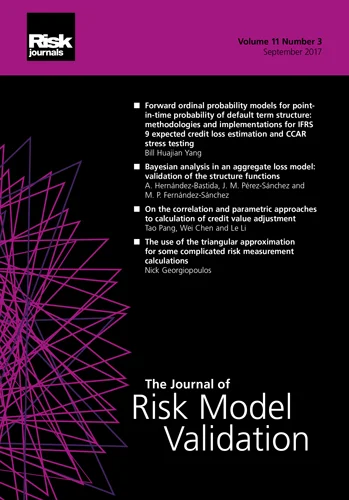
Journal of Risk Model Validation
ISSN:
1753-9587 (online)
Editor-in-chief: Steve Satchell

Addendum to Rubtsov and Petrov (2016): “A point-in-time–through-the-cycle approach to rating assignment and probability of default calibration”
Abstract
In June 2016, The Journal of Risk Model Validation published a paper by Rubtsov and Petrov (2016) called “A point-in time–through-the-cycle approach to rating assignment and probability of default calibration”. This paper included a system of equations that were solved numerically. Following publication, Torsten Pyttlik and Roland Wolff proposed an analytical solution, which the authors believe adds substantial value to their original work. In the attached PDF the authors have written a short follow-up, presenting the details of that analytical solution.
Introduction
In June 2016, The Journal of Risk Model Validation published a paper by Rubtsov and Petrov (2016) called “A point-in-time–through-the-cycle approach to rating assignment and probability of default calibration”. On p. 102 of the paper, the authors solved a system of equations (5.7)–(5.9) numerically; these equations are reproduced below as (1)–(3):
| (1) | ||||
| (2) | ||||
| (3) |
Torsten Pyttlik has recently proposed an analytical solution to this system, and we present the details of that solution below. We believe it adds substantial extra value to the original material.
Let for brevity. The original equations (5.7)–(5.9) then become
| (4) | ||||
| (5) | ||||
| (6) |
Rearranging (4) gives
| (7) |
Taking the square of (4) and subtracting that from (5) and then rearranging gives us
| (8) | ||||
| (9) |
Here, we have introduced the variance, defined as
Note that (9) might result in if , which is undesirable since was defined as a variance when the original system of equations was set up. Negative values of could therefore be considered, which would require an extensive modification of (1)–(3), using and changing signs in several places.
Taking the third power of (4) and subtracting this from (6) gives
Inserting (7) and (9) into the inner square brackets on the right-hand side yields, after rearranging, an expression that is solvable for alone:
| (10) |
Here, we have defined
which is the nonnormalized skewness (to obtain normalized skewness, multiply by ).
Note that if the distribution of is symmetrical, ie, , then (10) has no solution if . There is no unique solution if both and . For the limiting case , the whole system of equations (4)–(6) would be invalid.
References
Rubtsov, M., and Petrov, A. (2016). A point-in-time–through-the-cycle approach to rating assignment and probability of default calibration. The Journal of Risk Model Validation 10(2), 83–112 (http://doi.org/bzcb).
コンテンツを印刷またはコピーできるのは、有料の購読契約を結んでいるユーザー、または法人購読契約の一員であるユーザーのみです。
これらのオプションやその他の購読特典を利用するには、info@risk.net にお問い合わせいただくか、こちらの購読オプションをご覧ください: http://subscriptions.risk.net/subscribe
現在、このコンテンツを印刷することはできません。詳しくはinfo@risk.netまでお問い合わせください。
現在、このコンテンツをコピーすることはできません。詳しくはinfo@risk.netまでお問い合わせください。
Copyright インフォプロ・デジタル・リミテッド.無断複写・転載を禁じます。
当社の利用規約、https://www.infopro-digital.com/terms-and-conditions/subscriptions/(ポイント2.4)に記載されているように、印刷は1部のみです。
追加の権利を購入したい場合は、info@risk.netまで電子メールでご連絡ください。
Copyright インフォプロ・デジタル・リミテッド.無断複写・転載を禁じます。
このコンテンツは、当社の記事ツールを使用して共有することができます。当社の利用規約、https://www.infopro-digital.com/terms-and-conditions/subscriptions/(第2.4項)に概説されているように、認定ユーザーは、個人的な使用のために資料のコピーを1部のみ作成することができます。また、2.5項の制限にも従わなければなりません。
追加権利の購入をご希望の場合は、info@risk.netまで電子メールでご連絡ください。