

House of the Year, South Korea: Samsung Securities
Asia Risk awards 2011 winner: Samsung Securities – House of the Year, South Korea
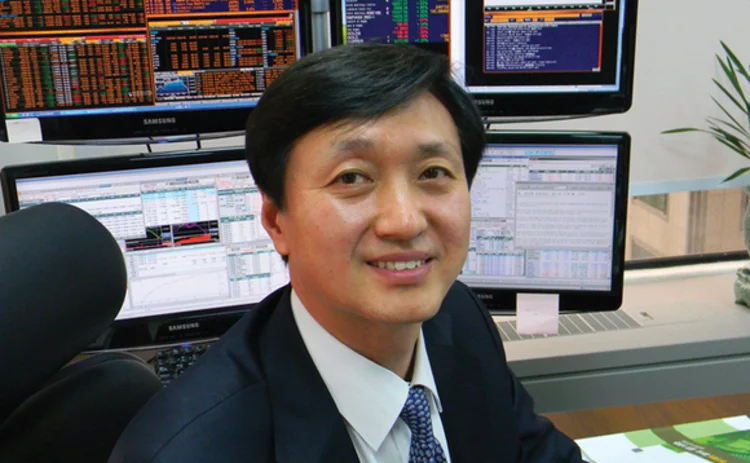

Dealers operating in South Korea have had a tumultuous past 12 months, as they have moved to help clients navigate substantial price volatility in equity, currency and interest rate markets. This, combined with supervisory investigations into a number of business practices taking place in the country, has put many counterparties under sustained pressure.
Samsung Securities has not emerged unscathed. The broker is still under investigation – alongside 11 other leading brokers – over whether or not its provision of direct market access (DMA) to clients trading equity-linked warrants resulted in the firm breaching the Financial Investment Services and Capital Markets Act. And a cloud still lingers over Samsung Securities chief executive, Chun-hyeon Park, who is the subject of criminal proceedings. But Samsung Securities says DMA is a widely used trading method allowed in many countries and the segregation of algorithmic traders from other traders is necessary to ensure algorithmic trader orders, which are sent in bulk, do not delay other investor orders.
Spade work
While the result of these investigations is pending, Samsung Securities has also made headlines for the right reasons. Volumes of equity and index-linked structured products have increased at a time when many investors are taking money off the table due to stock market volatility. The securities firm has seen trade volume, number of trades and clients grow significantly, in large part due to the roll-out of its proprietary structured products active designing engine (Spade) to private bankers.
Spade allows private bankers at Samsung Securities to cut down the time spent structuring transactions from two days at best to a matter of minutes, which means they can offer real-time pricing for structures linked to Korean equities and a variety of equity indexes – something that only a few international dealers had achieved previously. Documentation and term sheets are also generated instantly through the Spade system.
The efficiency of Spade has enabled average trade ticket values to fall as Samsung Securities reduced its minimum trade size from 1 billion won to 300 million won, opening up a major market segment for the firm. Spade is now handling 59% of all structures done by Samsung Securities and has helped total volume of equity-linked securities increase to more than 970 billion won ($820 million) in the first quarter of 2011.
Insung Park, senior vice-president in the capital market business division at Samsung Securities in Seoul, says Spade has helped the firm manage its risk profile by enabling it to monitor trades electronically, meaning it can rapidly move to stop trades on a particular underlying if its books become too concentrated.
“We know, for example, Samsung Electronics is very popular at different times in the year. So we can monitor how many structured notes include this as the underlying, and if [the positions are] too concentrated then we can remove them from the list of options,” says Park.
Moreover, with 50 equity or equity index underlyings actively trading on Samsung Securities’ platform, the chance of investors concentrating their investment in a single or pair of underlying equities or indexes is reduced, Park claims. “If our private bankers want to structure a note with a pair of underlyings this means 1,200 combinations, all of which are well diversified.”
The reduced ticket sizes also help. “When it was 1 billion won minimum investment per trade, this amount might affect the price of some underlyings when we turn around to hedge it out, but with smaller 0.3 billion won trades it is easier to hedge out,” says Park. Also, smaller ticket sizes can make it easier to find liquidity on a dynamic basis. “The trades are all booked and grouped together and the greeks are all processed automatically, so we can hedge out the risk faster,” Park adds.
The platform can also be used to structure notes for institutional investors or corporate clients with knock-in, knock-out and other trigger events easily built into structures – although there is no functionality for restructuring trades. During the next year. Samsung Securities plans to add fixed income notes linked to certificates of deposit range accruals as well as, potentially, underlyings linked to gold and oil.
Only users who have a paid subscription or are part of a corporate subscription are able to print or copy content.
To access these options, along with all other subscription benefits, please contact info@risk.net or view our subscription options here: http://subscriptions.risk.net/subscribe
You are currently unable to print this content. Please contact info@risk.net to find out more.
You are currently unable to copy this content. Please contact info@risk.net to find out more.
Copyright Infopro Digital Limited. All rights reserved.
As outlined in our terms and conditions, https://www.infopro-digital.com/terms-and-conditions/subscriptions/ (point 2.4), printing is limited to a single copy.
If you would like to purchase additional rights please email info@risk.net
Copyright Infopro Digital Limited. All rights reserved.
You may share this content using our article tools. As outlined in our terms and conditions, https://www.infopro-digital.com/terms-and-conditions/subscriptions/ (clause 2.4), an Authorised User may only make one copy of the materials for their own personal use. You must also comply with the restrictions in clause 2.5.
If you would like to purchase additional rights please email info@risk.net
More on Awards
Regulatory capital calculation product of the year: Regnology
Regnology’s cloud-native platform helps banks streamline regulatory capital calculation while strengthening strategic decision-making

Prudential regulation reporting system of the year: Regnology
Regnology’s cloud-native platform helps firms unify risk, regulatory reporting and finance on a single data foundation, using AI‑ready architecture to support future innovation

CTRM software house of the year: Hitachi Energy
Energy Risk Awards 2026: Software developer’s portfolio approach meets changing needs of energy market participants

Climate risk service of the year: First Street
First Street helps institutions translate climate science into asset-level intelligence that supports investment, lending and risk decisions

Integrated risk management software of the year: TS Imagine
TS Imagine’s integrated risk platform helps clients monitor exposures across markets, counterparties and asset classes amid increasingly complex trading environments

Life and pensions ALM system of the year: Fentics Technology
Fentics’ ALM and capital platform helps insurers and pension providers manage balance sheets by bringing assets, liabilities and capital together within a single modelling framework

Best in-house ALM technology: EFG Bank
The EFG ALM Risk Suite has shifted ALM from a retrospective reporting exercise into a forward-looking, strategic discipline

Best use of AI: Moody’s
Moody’s Banking Decision Intelligence solution uses AI to bring together credit, liquidity, capital, profitability and other insights
