Commodities Trading and Investment Summit: conference highlights
Commodity contest
After the break, the conference split into an energy stream and a softs and metals stream.
In energy, senior research fellow at the Oxford Institute of Energy Studies, Patrick Heather, warned the conference that the US shale gas revolution could not be repeated in Europe, where costs were much higher and geological resources more limited. There would be no significant shale gas volume produced in Europe before 2020, he said.
Sabine Schels, senior director and global strategist at Bank of America Merrill Lynch (BAML), next answered the question of whether we were going to see a repeat of 2008 in oil markets. She noted that although the absence of the Organisation of Petroleum Exporting Countries as a limiter of upward risk made a 2008 repeat more likely, it was still not BAML’s main view. However, the second round of US QE helped push all commodities upwards, especially oil.
Schels argued that negative real interest rates generally led to high and bubbly oil prices. Conversely, India’s raising of interest rates by 50 basis points led to the sell-off in commodities in May.
The world was fast losing its spare productive capacity in oil, Schels said, with an obvious supply/demand imbalance. If Libyan production doesn’t return in 2012, we will eat into another one million barrels per day of spare capacity.
Next, Henrik Hasselknippe, managing director of product development at Green Exchange, provided a look into the future of carbon trading. He noted some upcoming jurisdictional clashes in Europe, while the UK carbon allowances are treated as normal property rights. The Markets in Financial Instruments Directive review might classify carbon credits as financial instruments even though, at the moment, they are treated differently in each EU country.
After lunch, Tim Greenwood from the European Energy Exchange (EEX) expounded on how power could be traded as an alternative asset class. While investors had been scared away in the past by the extreme volatility and special characteristics of power markets, there was an increasing number of financial participants on EEX, he said.
Wind generation was having an unpredictable effect on short-term power markets, Greenwood said, and through the tight link between spot and futures prices, it has impacts on long-term price signals as well.
ETF effect
The effect of exchange-traded funds on broader commodity markets is a hot topic nowadays. Speaking on this was John Hyland, chief investment officer at US Commodity Funds –manager of the popular US Oil Fund and US Natural Gas Fund.
Hyland said it was ridiculous to assert that physically-backed gold ETFs were ‘hoarding’ gold, when they were the only market participants who were obliged to sell you some of their gold holdings whenever you wanted.
After a coffee break, Jason Lejonvarn, strategist at Hermes Fund Managers, took an analytical look at how well commodity investments work as a diversifier. He said, as a rule, commodities performed well late in the business cycle, while equities did well early in the cycle. In 2008, commodities had a six-month lag before they were brought down by the financial crisis, Lejonvarn said.
Result of regulation
The day was rounded off by a lively panel discussion on how new regulation would change trading and investment.
Homayoon Arfazadeh reminded participants that new regulation on market manipulation didn’t require proof of intent, just proof that a position was causing distortion. This would make it much easier to prosecute for manipulation.
Hyland said airlines and every other end-user would argue for an end-user exemption, even when it didn’t make sense. However, he had serious doubts about the timeline for implementation, which was causing serious uncertainty for market participants. “We’ll be back here in June 2012, and we still won’t know what the rules will be,” he said.
Only users who have a paid subscription or are part of a corporate subscription are able to print or copy content.
To access these options, along with all other subscription benefits, please contact info@risk.net or view our subscription options here: http://subscriptions.risk.net/subscribe
You are currently unable to print this content. Please contact info@risk.net to find out more.
You are currently unable to copy this content. Please contact info@risk.net to find out more.
Copyright Infopro Digital Limited. All rights reserved.
As outlined in our terms and conditions, https://www.infopro-digital.com/terms-and-conditions/subscriptions/ (point 2.4), printing is limited to a single copy.
If you would like to purchase additional rights please email info@risk.net
Copyright Infopro Digital Limited. All rights reserved.
You may share this content using our article tools. As outlined in our terms and conditions, https://www.infopro-digital.com/terms-and-conditions/subscriptions/ (clause 2.4), an Authorised User may only make one copy of the materials for their own personal use. You must also comply with the restrictions in clause 2.5.
If you would like to purchase additional rights please email info@risk.net
More on Risk management
EU can handle energy price pressure – it’s been here before
Reforms made after Russia’s invasion of Ukraine have made region more resilient to energy shocks, officials say
Rising reliance on internal auditors spooks regulators and industry
Risk managers warn US is substituting supervisors with auditors; could compromise independence

What futures and options say about the cost of war
Spot prices reveal major disruption, futures indicate this will pass, options imply ongoing instability
For collateral, can TINA become TIA?
US Treasuries’ dominance as collateral in repo and derivatives is no longer set in stone, argues economist
CME-FICC cross-netting terms fuel clashes
Hedge funds worried by CCP powers to suspend arrangement; clearing members say it’s standard practice

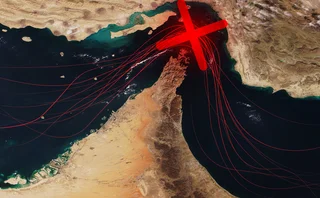
A Hormuz tipping point may be days away
Agent-based model suggests delays and shortages likely to accelerate after four weeks
Op risk data: HK gets tough on takeover in $200m takedown
Also: Bank staff steal state funds in India; Vanguard settles US net zero lawsuit. Data by ORX News

CRO view: Emerging risks in the age of AI
The risk agenda is shifting beyond market and credit volatility towards operational resilience, AI governance and culture