Trade of the month: Autocallables

Autocallables remain popular products, helped by the offer of high target returns (pseudo-yield) in excess of what is achievable by a reverse convertible linked to the same underlying over the same period.
Autocallables come in many forms. The typical construction requires the underlying index to be above its initial level at various times during the investment. This might be annually for a five-year investment and perhaps monthly or quarterly for a shorter-dated product.
The most popular type promises a high annualised payment if kickout occurs on an anniversary dates as a result of the index being above its start level. If this does not happen, the product returns capital at best, but will lose capital if the barrier has been breached and the index is down at maturity. Variations include an increasing or decreasing series of call levels and the use of several indexes.
Proper modelling techniques are required to get an idea of the pricing and risk of an autocall, but simple intuition is a decent guide. For example, compare an autocall to a reverse convertible, both with a six-year maturity and the same underlying, say the FTSE 100. Both have the same downside risk, for example a 50% knock-in barrier. The reverse convertible pays its annual income for the full product maturity; the autocall only pays the ‘pseudo'-income if the call option is exercised.
For typical products, the average time to call is about half the full maturity, and the probability of being successfully called is around 75%. The main difference between the autocall and reverse convertible is that the former typically pays its income for much less than the full investment and there is a significant chance that no income is paid. The downside condition appears to be the same for both products.
The best way to equate the products is to consider the amount of income paid above the risk-free rate per year (see table). This takes account of the fact that the autocall will pay its principal back earlier if the call option is exercised.
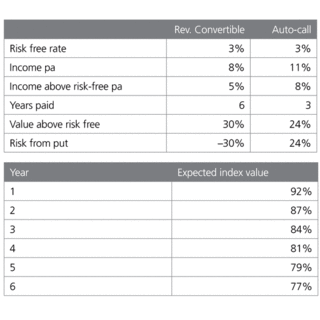
A new variation in the UK market is examined in the Morgan Stanley product analysed in this issue ). If on any anniversary of this six-year product the FTSE 100 is above 100%, then it is called. The amount received is 11.5% in year one if called; from year two, if called it pays the greater of the fixed return (11.5% times number of years elapsed) and the highest level of the index.
The lookback feature at year two can be thought of as roughly a 134% strike one-year lookback call. This is because the expected value of the index is 92% if the product goes through to year two. The index would need to be higher than 123% after two years, thus it needs to rise by 34% at some point in year two, which has very limited value.
Only users who have a paid subscription or are part of a corporate subscription are able to print or copy content.
To access these options, along with all other subscription benefits, please contact info@risk.net or view our subscription options here: http://subscriptions.risk.net/subscribe
You are currently unable to print this content. Please contact info@risk.net to find out more.
You are currently unable to copy this content. Please contact info@risk.net to find out more.
Copyright Infopro Digital Limited. All rights reserved.
As outlined in our terms and conditions, https://www.infopro-digital.com/terms-and-conditions/subscriptions/ (point 2.4), printing is limited to a single copy.
If you would like to purchase additional rights please email info@risk.net
Copyright Infopro Digital Limited. All rights reserved.
You may share this content using our article tools. As outlined in our terms and conditions, https://www.infopro-digital.com/terms-and-conditions/subscriptions/ (clause 2.4), an Authorised User may only make one copy of the materials for their own personal use. You must also comply with the restrictions in clause 2.5.
If you would like to purchase additional rights please email info@risk.net
More on Structured products
A guide to home equity investments: the untapped real estate asset class
This report covers the investment opportunity in untapped home equity and the growth of HEIs, and outlines why the current macroeconomic environment presents a unique inflection point for credit-oriented investors to invest in HEIs

Podcast: Claudio Albanese on how bad models survive
Darwin’s theory of natural selection could help quants detect flawed models and strategies

Range accruals under spotlight as Taiwan prepares for FRTB
Taiwanese banks review viability of products offering options on long-dated rates

Structured products gain favour among Chinese enterprises
The Chinese government’s flagship national strategy for the advancement of regional connectivity – the Belt and Road Initiative – continues to encourage the outward expansion of Chinese state-owned enterprises (SOEs). Here, Guotai Junan International…

Structured notes – Transforming risk into opportunities
Global markets have experienced a period of extreme volatility in response to acute concerns over the economic impact of the Covid‑19 pandemic. Numerix explores what this means for traders, issuers, risk managers and investors as the structured products…

Structured products – Transforming risk into opportunities
The structured product market is one of the most dynamic and complex of all, offering a multitude of benefits to investors. But increased regulation, intense competition and heightened volatility have become the new normal in financial markets, creating…

Increased adoption and innovation are driving the structured products market
To help better understand the challenges and opportunities a range of firms face when operating in this business, the current trends and future of structured products, and how the digital evolution is impacting the market, Numerix’s Ilja Faerman, senior…

Structured products – The ART of risk transfer
Exploring the risk thrown up by autocallables has created a new family of structured products, offering diversification to investors while allowing their manufacturers room to extend their portfolios, writes Manvir Nijhar, co-head of equities and equity…