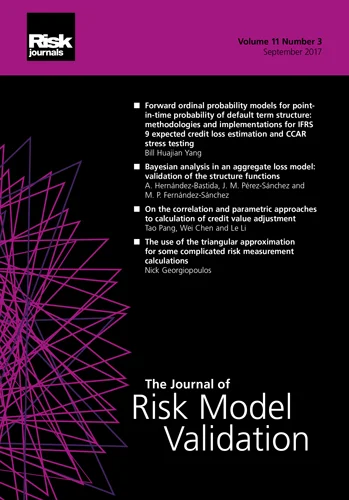
Journal of Risk Model Validation
ISSN:
1753-9587 (online)
Editor-in-chief: Steve Satchell
About this journal
As monetary institutions rely greatly on economic and financial models for a wide array of applications, model validation has become progressively inventive within the field of risk. The Journal of Risk Model Validation focuses on the implementation and validation of risk models, and aims to provide a greater understanding of key issues including the empirical evaluation of existing models, pitfalls in model validation and the development of new methods. We also publish papers on back-testing. Our main field of application is in credit risk modelling but we are happy to consider any issues of risk model validation for any financial asset class.
The Journal of Risk Model Validation considers submissions in the form of research papers on topics including, but not limited to:
- Empirical model evaluation studies
- Backtesting studies
- Stress-testing studies
- New methods of model validation/backtesting/stress-testing
- Best practices in model development, deployment, production and maintenance
- Pitfalls in model validation techniques (all types of risk, forecasting, pricing and rating)
Abstracting and Indexing: Scopus; Web of Science - Social Science Index; EconLit; Econbiz; and Cabell’s Directory
Journal Metrics:
Journal Impact Factor: 0.6
5-Year Impact Factor: 0.4
CiteScore: 1.1
Latest papers
Beyond mirror validation: the cost of ineffective challenge in model risk management
The authors demonstrate that the practice of confirming a developer’s model is correctly reimplemented and discrimination metrics are acceptable while leaving calibration under changing conditions unchallenged fails to detect calibration degradation.
Identifying supply chain credit risk in China’s textile industry using an ensemble explainable artificial intelligence model
The authors focus on data mining of financial credit risk information and knowledge in the supply chain from the perspective of explainable artificial intelligence to address credit risk identification in supply chain enterprises.
Bayesian unsmoothing for private market investments: a probabilistic approach to risk estimation
This paper puts forward a Bayesian unsmoothing method to model smoothing parameters probabilistically which mitigates limitations of traditional methods.
A hybrid value-at-risk/estimated shortfall model: linking accuracy, calibration and explanation stability across horizons
In an effort to close the gap between predictive performance and auditability in hybrid risk models the authors put forward an auditable hybrid quantile framework that anchors nonlinear gradient boosting corrections to a linear heterogeneous…
The application of a corporate bond default risk-identification model to digital economic security
This paper proposes a CatBoost-based model incorporating corporate revenue performance and governance metrics to assess the likelihood of bond default and improve prediction accuracy.
The role of dynamic measurement and early warning in China’s stock-market resilience: evidence from 28 industry sectors
The authors measure China's stock market resilience across two dimensions: absorption intensity and duration.
A novel budget-based C+SVM model for credit risk prediction
The authors propose a modified support vector machine model based on load budget with which to predict credit risk.
Graph neural networks for credit default prediction: robustness and model evaluation
The authors evaluate the robustness and performance of graph-based models in credit default prediction.
Generative artificial intelligence in model risk management: emerging opportunities, supervisory challenges and validation frameworks
The author proposes a structured approach to validating generative AI models in line with the principles of current regulatory standards.
A dual backtesting framework for quantifying nested model error and unlocking capital efficiency
The author puts forward a framework for dual backtesting, in which single-blind backtesting assesses core models and double-blind backtesting evaluates the whole system.
Validating bank risk models under trade war stress: a framework for adaptive stress testing with AI-driven calibration and cross-industry applications
Focusing on validating and enhancing risk models, the author proposes a comprehensive framework through which to stress test under trade war conditions.
Quantitative fund homogenization and systemic risk in the stock market
The authors develop a homogenization measurement method from the perspectives of return rates and Sharpe ratios based on data from 421 active quantitative funds in China from January 2015 to March 2024.
Exceedance-based backtesting of expected shortfall
The authors apply exceedance-based validation techniques often used for VaR model validation the the validation of ES models, showing such an application to be feasible.
Demand deposit balance prediction models under the interest rate risk in the banking book guidelines: an empirical analysis integrating time-series models and machine learning predictions in Mexican banks
The authors analyze the interest rate risk in the banking book regulations, arguing that financial institutions must develop robust models for forecasting demand deposit balances while adhering to regulatory guidelines.
Crises, combined crises and their implications for firm profitability
The authors put forward a taxonomy for combined crises where up to four accompanying crises are apparent and how their interactions might impact firm profitability.
The role of personal credit in small business risk assessment: a machine learning approach
The authors investigate how personal credit data can be combined with business-level and tradeline variables in a machine learning framework to enhance default prediction.
Interpretable machine learning for default risk prediction in stress testing
This paper proposes a benchmark model which can be used to predict the forward-looking probability of default of a real-world credit card portfolio.
Statistically distinguishable rating scales
The author suggests a means to design a statistically distinguishable rating scale that is not excessive in relation to the existing observation statistics, allowing for more stable validation.
Green risk identification and risk measurement in fintech: a particle swarm optimization fuzzy analytic hierarchy process and sparrow search algorithm quantile regression neural network approach
The authors apply PSO-FAHP and SSA-QRNN models to identify and measure financial risks in the fintech sector.
An aggregated metrics framework for multicriteria model validation using rolling origin evaluation
The authors apply the rolling origin evaluation framework to model validation in multicriteria settings, where performance must be assessed through various scenarios or forecast targets.