The ETF liquidity mirage
ETFs are supposed to provide investors with deep pools of liquidity, but Europe’s fragmented market structure makes it all but impossible to gauge what the true picture is. Regulators are concerned about the lack of transparency and some warn that ETFs could be conduits for the transmission of liquidity shocks to other markets. By Andrew Capon

When Napoleon invaded Egypt in 1798 with his 45,000-strong Armée d’Orient, he took with him more than 150 scientists and scholars. They included Gaspard Monge, the founder of the renowned École Polytechnique. As the army marched across the desert from Alexandria to Cairo, Monge observed a strange phenomenon. On the horizon, there would often appear to be a large body of water. But as the thirst-wracked soldiers approached, their vision retreated and then disappeared. In Mémoires sur l’Égypte (1800), he wrote the first scientific explanation of mirages.
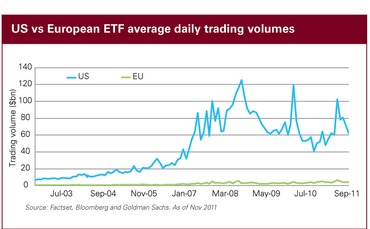
Someone viewing exchange-traded funds (ETFs) in Europe for the first time, having heard the product has liquidity as part of its very DNA, may also feel like the unwitting victim of an optical illusion. The pool of ETFs – 1,270 at the end of February – looks deep and alluring. But those tempted to dive in with a big order might want to look again, as European ETFs appear to suffer from a severe liquidity deficit compared to their US cousins (see chart).
Damned lies and statistics
The statistics seem to bear this out. ETFs make up 25% of overall cash equity turnover on exchanges in the US, but just 7% in Europe. The most actively traded equity ETF listed in London – the iShares FTSE 100 – trades less in a week than Lloyds Banking Group regularly does in a day. But as Monge and his confreres discovered, appearances can prove deceptive. The somewhat surprising reality is that no-one knows what the true trading volumes in Europe are.
This is partly attributed to liquidity fragmentation. To satisfy investor demand for locally listed funds, European ETFs are on average listed on four different exchanges, with some listed on as many as 15. This means that liquidity for a single, cross-listed ETF can be split between multiple venues in Europe, making it difficult to garner an accurate picture of overall trading volumes.
In addition, the majority of ETF trading in Europe is conducted in the over-the-counter market, rather than on an exchange. Under current rules, these trades do not need to be reported, although the London Stock Exchange and Six Swiss Exchange both require OTC transactions on their listed ETFs to be reported to them. For the most part, though, a huge number of trades are not recorded anywhere.
Regulators have become concerned about this lack of transparency – as have many ETF providers, which feel greater transparency will encourage investors to trade more frequently. In response, regulators have proposed a so-called consolidated tape to improve post-trade transparency, similar to what is already in place in the US. The proposal – part of the revisions to the Markets in Financial Instruments Directive (Mifid II) – would capture post-trade data across a swath of asset classes, including ETFs. The problem is that Mifid II is currently in the consultation phase and is unlikely to be finalised until 2014 – much to the frustration of some in the industry. “A trade tape is long overdue,” says Joseph Linhares, Europe, the Middle East and Africa head of iShares, part of asset manager BlackRock.
If the currently reported ETF trading volumes in Europe are a mirage, then what is the reality? Product providers argue a more complete picture can be obtained by looking at the liquidity of the underlying securities being tracked by the ETF. That is because of the unique role played by authorised participants (APs) in the creation and redemption of ETF units. Each time an AP wants to purchase a creation unit in the primary market, it would need to acquire a basket of securities that mirrors the ETF index and deliver it to the ETF sponsor. Each creation unit – typically comprising 50,000 shares in the ETF – can then be split up and sold to investors. The AP can redeem creation units with the ETF sponsor in return for the underlying securities.
“This process means that the only right measure for the liquidity of an ETF is the liquidity of the underlying,” argues Margot Pages, head of index funds and ETF development at Theam, part of BNP Paribas.
Only users who have a paid subscription or are part of a corporate subscription are able to print or copy content.
To access these options, along with all other subscription benefits, please contact info@risk.net or view our subscription options here: http://subscriptions.risk.net/subscribe
You are currently unable to print this content. Please contact info@risk.net to find out more.
You are currently unable to copy this content. Please contact info@risk.net to find out more.
Copyright Infopro Digital Limited. All rights reserved.
As outlined in our terms and conditions, https://www.infopro-digital.com/terms-and-conditions/subscriptions/ (point 2.4), printing is limited to a single copy.
If you would like to purchase additional rights please email info@risk.net
Copyright Infopro Digital Limited. All rights reserved.
You may share this content using our article tools. As outlined in our terms and conditions, https://www.infopro-digital.com/terms-and-conditions/subscriptions/ (clause 2.4), an Authorised User may only make one copy of the materials for their own personal use. You must also comply with the restrictions in clause 2.5.
If you would like to purchase additional rights please email info@risk.net
More on Exchange-traded products
Realising the China opportunity
Webinar: HKEX

One size does not fit all: Smart beta explained
Sponsored feature: WisdomTree Europe

ETF Risk European Rankings 2015: ETF trading platform for institutional investors
Sponsored feature: Tradeweb
ETFs – Transforming the investment landscape in Asia
Sponsored survey analysis: Deutsche Asset & Wealth Management

Flood of oil ETF investors reshaping market, analysts say
'Massive' inflows cushioned oil price drop in early 2015, but could easily reverse

Currency-hedged ETF surge prompts hedging concerns
Eurozone QE programme prompts wave of investor interest

Currency-hedged ETF inflows boom
Investor interest sparks race to construct new products

Shanghai ETF option volatility spikes on China market fears
A crackdown on margin financing strengthens bearish sentiment