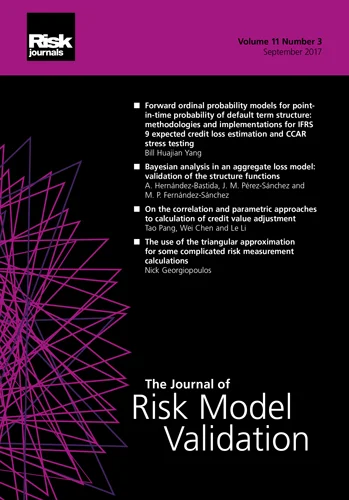
Journal of Risk Model Validation
ISSN:
1753-9587 (online)
Editor-in-chief: Steve Satchell
About this journal
As monetary institutions rely greatly on economic and financial models for a wide array of applications, model validation has become progressively inventive within the field of risk. The Journal of Risk Model Validation focuses on the implementation and validation of risk models, and aims to provide a greater understanding of key issues including the empirical evaluation of existing models, pitfalls in model validation and the development of new methods. We also publish papers on back-testing. Our main field of application is in credit risk modelling but we are happy to consider any issues of risk model validation for any financial asset class.
The Journal of Risk Model Validation considers submissions in the form of research papers on topics including, but not limited to:
- Empirical model evaluation studies
- Backtesting studies
- Stress-testing studies
- New methods of model validation/backtesting/stress-testing
- Best practices in model development, deployment, production and maintenance
- Pitfalls in model validation techniques (all types of risk, forecasting, pricing and rating)
Abstracting and Indexing: Scopus; Web of Science - Social Science Index; EconLit; Econbiz; and Cabell’s Directory
Journal Metrics:
Journal Impact Factor: 0.6
5-Year Impact Factor: 0.4
CiteScore: 1.1
Latest papers
Optimal allocation of model risk appetite and validation threshold in the Solvency II framework
In this paper, the authors derive an analytical solution for sub-SCR VTs starting with a model risk appetite (MRA) that defines acceptable errors for an insurer’s total SCR.
Shrunk volatility value-at-risk: an application on US balanced portfolios
In this paper, the authors adopt a new method of predicting VaR, to estimate balanced portfolios’ VaR.
Evaluating the risk performance of online peer-to-peer lending platforms in China
The objective of this paper is to select effective risk indicators and thus establish a risk index system of P2P platforms so as to evaluate the risk performance of these platforms in China.
The predictability implied by consumption-based asset-pricing models: a review of the theory and empirical evidence
This paper examines whether two well-known models, Campbell and Cochrane’s habit model and Bansal and Yaron’s long-run risks model, can produce significant return predictability.
Smoothing algorithms by constrained maximum likelihood: methodologies and implementations for Comprehensive Capital Analysis and Review stress testing and International Financial Reporting Standard 9 expected credit loss estimation
In this paper, the author proposes smoothing algorithms that are based on constrained maximum likelihood for rating-level PD and for rating migration probability.
Underperforming performance measures? A review of measures for loss given default models
This paper reviews the ways of measuring the performance of LGD models that have been previously used in the literature and also suggests some new measures.
A central limit theorem formulation for empirical bootstrap value-at-risk
In this paper, the importance of the empirical bootstrap (EB) in assessing minimal operational risk capital is discussed, and an alternative way of estimating minimal operational risk capital using a central limit theorem (CLT) formulation is presented.
Model risk in the Fundamental Review of the Trading Book: the case of the Default Risk Charge
This paper assesses the model risk associated with the copula choice for the calculation of the Default Risk Charge (DRC) measure.
The validation of filtered historical value-at-risk models
In this paper, the authors examine the problem of validating and calibrating FHS VaR models, focussing in particular on the Hull and White (1998) approach with EWMA volatility estimates, given its extended use in the industry.
Validation of profit and loss attribution models for equity derivatives
The aim of this paper is to validate profit and loss attribution generated by daily movements of option prices as seen through their Black–Scholes (Black and Scholes 1973) and Merton (1973) implied volatilities.
A risk-sensitive approach for stressed transition probability matrixes
In this paper, the authors outline a simulation-based methodology for the generation of stressed transition probability matrixes under the structural credit risk framework.
The profit-and-loss attribution test
In this paper, the authors analyze the failure probabilities of the profit-and-loss attribution (PLA) test as defined in the final market risk standard published in January 2016 by the Basel Committee on Banking Supervision.
Governance and organizational requirements for effective model risk management
This paper expands on the foundation of model risk analytics to address the governance, organizational and human behavior challenges associated with enterprise MRM.
New historical bootstrap value-at-risk model
This paper presents a new value-at-risk (VaR) model for the estimation of market risk in banks and other financial institutions.
On the correlation and parametric approaches to calculation of credit value adjustment
This paper develops a connection between the Hull–White parametric approach and the PCL correlation approach for CVA calculation.
Bayesian analysis in an aggregate loss model: validation of the structure functions
This paper considers the empirical evaluation of a collective risk model with the geometric as the primary distribution and the exponential as the secondary distribution.
The use of the triangular approximation for some complicated risk measurement calculations
The author introduces the triangular approximation to the normal distribution in order to extract closed- and semi-closed-form solutions that are useful in risk measurement calculations.
Forward ordinal probability models for point-in-time probability of default term structure: methodologies and implementations for IFRS 9 expected credit loss estimation and CCAR stress testing
This paper proposes an ordinal model based on forward ordinal probabilities for rank outcomes.
A practical maturity assessment method for model risk management in banks
This paper proposes a qualitative method to assess the maturity of model risk management practices within banks.
Asset price bubbles and the quantification of credit risk capital with sensitivity analysis, empirical implementation and an application to stress testing
This paper presents an analysis of the impact of asset price bubbles on standard credit risk measures.