

Martin Currie European Absolute Alpha Fund: Martin Currie Investment Management
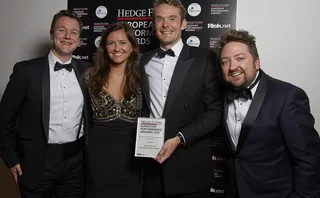
Winner of best equity hedge alternative Ucits fund
A strong focus on fundamental analysis is what gives the Martin Currie European Absolute Alpha Fund an edge over competitors.
"We believe that stock selection is the main driver of alpha generation and consequently our focus is on fundamental analysis and not trading," says Michael Browne, who runs the fund with co-portfolio manager Steve Frost. The two have been working together for 24 years and are investment directors of European long/short products for Martin Currie.
The European Absolute Alpha Fund has attracted interest from investors who normally favour long-only products but also want some degree of protection if things go wrong, according to Browne.
"That is obviously a flexibility that we have above other managers who are only involved in a long-only space," he says.
The fund has achieved a cumulative return of 15.3% since its launch in September 2010, although it suffered like most of its competitors from Europe's debt crisis in 2011, when returns fell 9%. Performance for 2013 was up 6.9% at the end of April.
The strategy is simple, Browne says. “We don't do anything complicated and nothing very clever, we just buy a good European company and we short those with problems. That is it,” he says.
“It is about finding corporates that create cash. If you create cash, the chances are you are doing the right thing,” he continues, “The flip side is if you destroy capital or you are using capital all the time you are not actually getting the return for that capital. Then the chances are you are doing something slightly wrong.”
The strategy utilises a bottom-up investment process based on extensive stock research.
The portfolio has no country limits but a broad European focus, including eastern Europe and Russia. Very large companies are excluded as "everyone knows everything about them and there is nothing we can add", says Browne.
Very small companies are also out. "We don't deal in small caps because we need to be able to clear a position. Our own defence at the end of the day is cash, is selling something or buying back something in the market. So we don't have illiquid stocks and we don't have illiquid positions."
The team focuses on a universe of up to 500 companies in the mid to large-cap range of European stocks. The company has operated in this area for 20 years as a long-only manager and, in the last decade, as a long/short manager.
The fund is a long-term investor in Turkey, which has gone through a resurgence after several crises. "We've been really impressed by the way the Turkish authorities and Turkish corporates have grasped the opportunities and gone forward," says Browne.
It has also been active in Russia's banking and oil sectors in the past, although not at present.
Looking at immediate prospects, Browne appears optimistic about the revival of the European economy, even though the recovery has stalled before.
"We feel that we are going through that recovery phase now and so we are looking for companies that have advantages within that phase," he says.
Most companies across a wide range of sectors are reporting disappointing first quarters but strong order inflows for the second quarter have encouraged investors, according to Browne. "For the first time in 18 months, managements’ tone and body language are positive,” he says.
Previous recoveries have stalled mainly because the banks could not or would not lend, Browne says. But that is changing.
"Now, talking to the various participants including the banks, there is a feeling the banks can finance a recovery and I think that is a sea change," he says.
To get a sense of the possible opportunities across the spectrum, the team uses a screening process that looks at price momentum and values and at the business cycle. Tools used include a proprietary macro matrix for quantitative analysis and a ‘traffic light system’ for qualitative assessments. Once that is completed, the managers look at sectors and stocks.
"You need to be able to assess your universe, to understand the company and its products and to have a view as to where we are from a macroeconomic point of view. Bringing those three elements together gives you that balance between growth to net, the sector, the countries," he says.
The traffic light system was developed after suffering some unexpected reversals around 10 years ago. "We have to be able to say where we think we are in terms of a bull market, a bear market or maybe something in between," he says.
The system consists of eight simple questions such as where is earnings momentum going to be in the next 12 months: is it red or negative, amber or flat, or green, which is better. The qualitative market traffic lights provide Browne with a strategic view, allowing him to optimise portfolio construction.
Browne says the system functioned brilliantly in August 2007 when it showed seven red lights suggesting the economy was about to enter into a bear market. It has taken several years for the indicator to change from mainly red lights to amber and it is only slowly turning to green.
"Today we have four green lights. I think we might have five by the end of the year, which would really be a confirmation of a positive outlook," he says.
The four green signals are low financial gearing, well-managed corporate costs, inexpensive valuations and underweight investor exposures. Amber signals cover earnings revisions, credit spreads and the corporate asset base. The one red (bear) signal is capital raising to repair balance sheets.
If there is a majority of green signals, Browne is more confident of a bull market.
Meanwhile, there are still some risks that could scupper a recovery. More eurozone bailouts remain a possibility, although Browne believes it is unlikely. Instead he believes even the slightest growth in Europe would have a big impact, improving fiscal receipts and making the debt to GDP ratios more manageable, thereby helping to rebuild confidence.
Concerns over parliamentary elections in Germany later this year could cause problems but Browne says this is also unlikely. "I think the elections will be very dull. I don't think they will provide a great deal of fireworks for us as investors, though I am sure they will provide plenty of fireworks within Germany," he says.
With no other major elections or political changes expected in Europe this year, 2013 should be calmer than 2012 for investors and markets.
The fear of a eurozone collapse may have receded but is not completely gone. The tricky part of reading Europe is its idiosyncratic approach to every issue and crisis it confronts.
"Europe deals with each individual issue separately. There is no real playbook, which is slightly confusing and worrying and makes you feel a little bit uncertain but actually it is unique. Each circumstance is addressed in a unique way. This may not provide much confidence but it gives at least a degree of understanding that maybe more 'muddle through' is likely than collapse," he says.
That uncertainty makes it more difficult to balance risk and reward.
That is always the toughest issue, says Browne. "If I am wrong, how much am I prepared to lose? That might sound like the most simple question in the world, but it is the critical question."
A combination of improvements in Europe and Japan would dramatically change the global outlook, he says. Outside factors will influence developments in Europe although the elephant in the room is the possibility of another European crisis. Japan's economy, sidelined for years, appears to be reviving and could provide a surprise for global GDP.
Despite this relative optimism on the global outlook, Browne believes the private sector could be the catalyst to lead the global economy out of recession. But as in all strategies, timing is everything.
"If you think [the global economy can revive], maybe you will be optimistic too early in the equity markets. The direction will be right and that may be more important than the timing."
So far this year the fund's best trades have been with banks, which have done a lot to consolidate their balance sheets, he says. People underestimated the amount of restructuring the banks have gone through, believes Browne.
"One bank said that for the first time in five years it can stop thinking about cutting and selling and wonder about growing its business. You can imagine the release that gives from a bank that has had to shrink and shrink. That release is really important,” he says, adding, “I go back to my credit surveys, which say banks are prepared to lend again for the first time in a long time. That is a really critical view."
These improvements have not yet been reflected in investor choices.
"What we have seen is dividend investment, people rebalancing their European equity portfolios, moving them from highly defensive to maybe a little bit more progress. What we haven't seen is cashflow coming into European equity markets, cash moving from bonds to equity or from cash holdings into equities," he says.
The recovery is barely beginning and investors are still concerned it could fizzle out again. This time it may be different, Browne says.
"We might actually push through this time and if so then some of the cash that has been building up on the sidelines, some of the deeply conservative portfolio construction will start to move and it will reach a fairly thin equity market so prices will move."
Fund facts
Name of fund: Martin Currie Absolute Alpha Fund
Portfolio managers: Michael Browne and Steve Frost
Management company: Martin Currie Investment Management
Contact details: Rachel Smith, senior marketing manager, Saltire Court, 20 Castle Terrace, Edinburgh EH1 2ES (+44 (0)131 479 5925; rsmith@martincurrie.com; www.martincurrie.com/european-long-short)
Strategy: European equity long/short
Launch: September 29, 2010 (Ucits version); January 1, 2001 (offshore fund)
Cumulative return since launch: 15.3% (Ucits); 123.0% (offshore) (at April 30, 2013)
Annualised volatility since launch: 6.2% (Ucits); 7.4% (offshore) (at April 30, 2013)
Return year to date: 6.9% (Ucits); 6.5% (offshore)
Sharpe ratio: 0.87 (Ucits) 0.60 (offshore)
Assets under management: $220 million (strategy)
Share classes: US dollar, euro and sterling (Ucits), US dollar (offshore)
Domicile: Luxembourg (Ucits); Cayman Islands (offshore)
Prime brokers: UBS (offshore)
Auditors: Deloitte (Ucits); Deloitte (Dublin; offshore)
Fund administrator: State Street Bank Luxembourg
Stock exchange listing: Luxembourg Stock Exchange (Ucits), Irish Stock Exchange (offshore)
Minimum investment: $250,000 (Ucits) $1 million (offshore)
Management fee: 1.5%
Performance fee: 20% with a high water mark
Subscription/redemption: daily (Ucits), monthly (offshore)
Only users who have a paid subscription or are part of a corporate subscription are able to print or copy content.
To access these options, along with all other subscription benefits, please contact info@risk.net or view our subscription options here: http://subscriptions.risk.net/subscribe
You are currently unable to print this content. Please contact info@risk.net to find out more.
You are currently unable to copy this content. Please contact info@risk.net to find out more.
Copyright Infopro Digital Limited. All rights reserved.
As outlined in our terms and conditions, https://www.infopro-digital.com/terms-and-conditions/subscriptions/ (point 2.4), printing is limited to a single copy.
If you would like to purchase additional rights please email info@risk.net
Copyright Infopro Digital Limited. All rights reserved.
You may share this content using our article tools. As outlined in our terms and conditions, https://www.infopro-digital.com/terms-and-conditions/subscriptions/ (clause 2.4), an Authorised User may only make one copy of the materials for their own personal use. You must also comply with the restrictions in clause 2.5.
If you would like to purchase additional rights please email info@risk.net
More on Hedge funds
JP Morgan warns hedge funds to expect intraday margin calls
US bank may demand variation margin ‘up to seven’ times a day after Archegos default
Alternative markets give edge to Florin Court strategy
By concentrating on exotic and alternative markets, Florin Court Capital Fund has sidestepped overcrowding and correlation to the main trend following commodity trading advisers, offering investors a diversified alternative to the standard systemic macro…

Global macro views combine with quantitative models to produce consistent returns
The team behind River and Mercantile Group’s global macro strategy team operates under two key principles: that macro is the most important aspect of any investment decision and that decision-making should incorporate both systematic and discretionary…
On the offensive – Seeking a new edge, buy-side invests in portfolio and risk analytics
A fast-moving, headstrong hedge fund – hit by rare losses after a black swan event touched on an overweight country exposure – ponders adding fresh quantitative expertise. Much to traders’ chagrin, the chief investment officer and chief operating officer…

Esma backtracks on account segregation
Status quo protected for rehypothecation of collateral in tri-party, securities lending and prime brokerage

Redemptions focused within strategies suffering losses in 2016
Redemptions focused within strategies suffering losses in 2016

Hedge fund redemptions a dismal end to a bad year
Managed futures funds saw big inflows in 2016, but left investors disappointed

Larger funds are net losers as outflows continue
Managed futures funds have seen biggest redemptions for three years