

Blackstone Alternative Asset Management (Baam)
Winner: Best fund of hedge funds group

When you are number one, the tendency is to look only at the numbers. While Blackstone Alternative Asset Management (Baam) may be the world’s largest discretionary allocator to hedge funds, it emphasises what it does differently rather than the amount of cash it manages.
Nevertheless, the significant amount of money Baam has gives it an edge over competitors as well as allowing it the freedom and scope to be more innovative and imaginative in how it approaches hedge fund investment.
Out of the $42 billion of assets under management (AUM) at June 2012, $19 billion was in customised investment solutions, $16 billion in commingled products and $3 billion in long-only. Smaller operations include Baam’s seeding platform with $1.4 billion invested (additional $1.5 billion committed), the special opportunities platform with $1.1 billion invested and $1.5 billion in regulated and bespoke products.
Over $1.3 billion of the company’s and employees’ assets are invested alongside client money. That gives Baam not only skin in the game but an alignment of interest with its clients few others can claim.
The novel approach has paid off handsomely. Unlike most other fund of hedge funds (FoHF) groups, Baam has been continuously increasing its AUM year on year. Not only is it gaining assets, it is getting a bigger share of existing clients’ allocations. Of the $9.7 billion raised in 2011, 60% came from existing investors allocating more to Baam.
“If we do our job, create good products, innovate, produce good risk-adjusted returns, the flow will be there as long as the opportunities are there,” says J Tomilson Hill, Baam’s president and CEO (pictured).
“Typically 50% plus of our asset flow each year comes from existing clients. These clients are giving us more assets not just because of our returns but because of our ability to give them different kinds of exposures.”
But Baam is not about the money or its dominance of the industry. It is about doing things differently. “What has differentiated our model from others is that from day one we were on a mission to be a provider of solutions to the largest investors in hedge funds around the world,” says Hill.
For him one size has never fitted all, especially in terms of relationships and risk. Investors have different needs depending on where the money is coming from, he says. They will have various return expectations and attitudes towards risk. Trying to understand what the client wants to accomplish with a particular programme is the starting point for discussions.
“A lot of the work we do up front is trying to understand the client’s risk/return objectives. Often that means analysing their entire portfolios, how much equity beta do they have, how much international exposure they have, what is their illiquidity profile, are they over/underweight in terms of other alternatives and in just trying to do a broad diagnostic of what their needs are. You can’t really come up with a solution until you understand what they are trying to accomplish,” says Hill.
In 2000 Baam was only a small business within Blackstone, managing about $1 billion, half of which was internal money.
Instead of following this traditional path, Baam decided to “have a clean sheet of paper for new relationships, particularly large ones where we can have a meaningful role”, says Hill.
New thinking
The stage was set for a different approach. From the outset Baam has focused on customisation. “It is about starting with the client, asking a series of questions about what that individual or company wants and then helping them build something that fits their risk/return expectations,” says Hill.
“The reason we’ve been able to grow whereas our competitors have generally been shrinking is that they are trapped in the old model of coming up with a product and trying to sell it,” notes Hill. The approach at Baam is to “get inside the head of the investor, figure out what they want and then build it for them”.
Hill believes the FoHF business does not really exist any longer. “Customisation is not easily achieved. In order to do it well, you need to have size and extensive resources to execute. Baam has been building its customised solutions since its inception. For example, we’ve got approximately 75 investment professionals around the world to help our clients create customised strategies. Importantly, we have also grown in size and with size you have clout. Customisation cannot be achieved if you don’t have influence in the marketplace to negotiate deals with the underlying hedge fund managers.” He likens Baam to Walmart. Baam has the purchasing power that enables it to go to hedge fund managers and negotiate better fees or ask them to build a specific strategy for the manager.
“If you’re an $8 billion provider, you don’t have that kind of purchasing clout. We represent $42 billion. We’ve got massive ability to put money to work with these talented managers,” continues Hill. “We’re able with our purchasing power to create special menus. If you don’t have size and you don’t have the people to negotiate, you can talk about customisation but you can’t execute.”
“Customisation is not just taking in $100 million and building a portfolio of the top 20 hedge funds,” says Brian Gavin, Baam’s chief operating officer. “Customisation is about creating unique exposures and products.”
John McCormick, responsible for all product development and head of global business strategy, agrees. “It’s getting customised exposure from the underlying hedge fund managers. Other folks are rearranging the deckchairs and calling it a custom portfolio. We’re going to the manager and because we have the people who can actually get into that manager’s portfolio and understand it, we’re identifying exposures that we want our clients to own,” he explains.
“We’re giving our clients exposures that don’t otherwise exist. We’re creating these investments and that’s very powerful. That shows up in returns,” McCormick adds.
The relationships with underlying managers can be through separate accounts where Baam owns all the capacity or through something developed specifically for the group, with tailor-made liquidity terms. Hill says Baam uses a variety of structures and is not wedded to just managed accounts. “We’ve used managed accounts in certain situations. They have a lot of flexibility in terms of notional funding with certain managers and strategies where they make sense. Other times they don’t make sense in terms of type of positions or in terms of tracking errors between a manager’s main fund and a managed account. Also the cost can be quite high,” he cautions.
“I think you have to evaluate each situation on its merits and make the best decision to seek to generate the best risk-adjusted returns. That’s the way we approach managed accounts versus commingled versus separate accounts,” Hill says.
“We don’t have a hard rule on this point,” adds McCormick. “It’s about whatever the right exposure is for the particular trade or what we’re trying to isolate. We have managed accounts in our business. We have funds of one. We are investors in co-investment vehicles and investors in commingled funds. What it’s really about is whether the tool is fit for the purpose we’re trying to accomplish for our investors.”
Baam also has the muscle to approach managers with a significant amount of cash to create something just for them. “Here are the liquidity terms, the fee terms we want to negotiate with you. And these are the types of exposures we want you to take in this portfolio because this is what we think you are best at,” says Gavin.
Innovation is another area where Hill and his team are proud of their record. As usual innovative solutions begin with the client. “We never come up with a strategy that is anything other than something we think fills a specific demand in the marketplace. We’re constantly talking to our investors about what it is they want,” says Hill.
Another rule of thumb, says Hill, is that Baam “never comes up with anything that we wouldn’t want to invest in ourselves”. That is why Baam rejected the traditional seeding models. Hill believes the old model of seeding did not necessarily attract the best.
Unlike other seeding models, this gives Baam the ability to monetise a minority interest that is typically 20%–25% of the fund over a three to five year period. “You also get a monetisation when the hedge fund buys its shares back or it’s sold in a third-party transaction to someone else, something that is quite common now,” adds Hill.
Compared with other seeders, Baam puts more money into the funds it wants – $100 million–$150 million in each of the funds, run by established teams that have either left a proprietary trade desk or are leaving established hedge funds. These are teams with a track record where Baam believes it can help them build their business. Having the Baam seal of approval also helps attract more assets for the fund, too.
Helping hand
Again, it is not just about the money. Baam also helps the funds it seeds hire people and make sure the risk management and operational side is in place. “These start-ups are fragile. It’s not just that this is a good investment team, they better also be able to run a business where they have robust risk management, understand their counterparty risks and negotiate third-party agreements, work out who is going to be their prime broker and get the best terms from the prime broker – the whole panoply of operational and business challenges that have to be buttoned down before you can be ready for the institutional marketplace,” says Hill.
The first of Baam’s ‘strategic alliance’ seeding funds raised more than $1.1 billion and invested in eight managers. A second fund with $2.4 billion in the drawdown structure followed. For Hill it is about seeing a window where there is demand in the institutional marketplace and designing a drawdown structure with which institutional investors felt comfortable.
“We have the ability to do the necessary research here at Baam. Our investors wanted to have a window into new talent, to get the economics of managers starting out through revenue shares and to get a window into making a direct investment down the road for their direct hedge fund programme,” remarks Hill.
The programme has not only benefited many start-up managers and given institutional investors a way into this area but also given Baam the dominant position in the seeding business.
Baam also used its relationship with underlying hedge fund managers to create a special opportunities platform. “We work very closely with our most trusted hedge fund managers to create co-investment opportunities. Everything is basically built and customised. We now have well over $1 billion in our special opportunities platform that is taking advantage of our relationships with these hedge fund managers to create very clear exposures,” Hill adds.
Technology is another area where Baam has been able to use its size to effect change. “We spend a lot of money in developing our risk, portfolio management and due diligence systems. Now that our clients have seen that technology, they’ve said ‘we need that too’. We’ve been putting it on the desktops of our major relationships. That’s another way through innovation that we have enhanced our relationships with investors,” explains Gavin.
There is no doubt that Baam’s size gives it an edge with both managers and investors. The question is, however, if Baam will encounter capacity constraints and if size actually disadvantages the group.
Hill thinks being big is a positive. He finds it difficult to come up with any disadvantages.
For Hill the question of size boils down simply to whether or not Baam can continue to make money for its clients. “We are constantly asking does our size inhibit our ability to generate returns on a risk-adjusted basis. In fact it’s just the opposite. If we’re not the top performer, guess what, we’d get redeemed,” concludes Hill.
“Our size has actually made us more nimble than when we were smaller,” continues Hill. Client relationships are characterised by flexibility while access to large amounts of capital allows Baam to take advantage of opportunities when they are spotted.
“When things come off the balance sheet in Europe, we can put different amounts of capital to work in a very short space of time. So we’ve actually become more nimble from that standpoint,” Hill says.
On the challenges of growing, Hill is even more confident of Baam’s future, particularly with 200 of what he terms “the most talented people out there”.
Hill and his team are also convinced that the $2.2 trillion run by hedge funds presently will significantly expand over the next three to four years to $5 trillion.
The new opportunity set of talented investors is one driver of this trend. The Volcker rule is a friend for the hedge fund world and is something Baam certainly thinks will stimulate the industry even more.
“We estimate that in 2007 and the first part of 2008 there was close to $600 billion maybe even $1 trillion of positions at the banks and investment banks that was in direct competition with hedge funds. That money has been scaled way, way back,” says Hill.
Baam believes the overall market will grow and that alpha is available in different marketplaces. Hill estimates there are around $140 trillion of market securities available to trade around the world and expects hedge funds to be the main players where he believes the “best and brightest” talent is available.
“Whether it’s regulations both [in the US] around what activities banks and investment banks can engage in or regulation in Europe around capital adequacy and the amount of capital banks have to hold against what they have on their balance sheet, you’re seeing them shrinking the activities they’ll engage in and being forced sellers of securities. We have not seen the avalanche of securities yet. We’re seeing it dribbling out but it’s increasing,” says McCormick.
This is creating a pool of securities for hedge funds to buy and at the same time making the banks less attractive as a workplace for people who like taking risks. “We are seeing a lot of talent exiting and moving into the hedge fund space. If anything we’re seeing a rapid growth in terms of both the opportunity set, the investable talent and investable landscape for us which makes it really exciting,” he adds.
Hill is equally confident that investors will also continue to see hedge funds as a good investment, as long as they take account of the risks. He says there are two main risks: fraud and incompetence. The trend of direct investment into hedge funds also does not faze Hill. He also says there is a reversal of the trend to go direct.
McCormick believes it is also about ensuring investors are getting the right advice.
Long-lasting relationships
Baam, he points out, has both small and large clients. The smaller clients often ask for advice and while the solution may initially be one of Baam’s commingled products, as they grow in size and experience, Baam is keen to help them develop through what McCormick terms their lifecycle.
Once investors become confident of hedge fund investment, Baam can offer something special, building out a customised exposure for them. McCormick stresses that Baam does not feel threatened by investors taking control of their hedge fund investments. Unlike competitors, he says, Baam sees this as an opportunity, not a threat.
“We’ve embraced and provided knowledge transfer and technology. We’ve provided due diligence advice to our investors and we’ve developed real long-lasting relationships because of it.”
Part of that relationship is trying to second-guess markets and events. Hill explains Baam has different scenarios it monitors and tracks. The scenarios are based in part on what Baam’s underlying managers are doing.
“At this point we have about 16 different scenarios, 60% of which are ok and 40% of which could be negative. We use that information to manage our portfolios, to say how much potential downside is there for a portfolio based on these events occurring. Based on that we’ve made some specific moves to our portfolios,” says Hill.
Such moves include taking down some of Baam’s fundamental equity exposure.
McCormick says there are some areas where Baam is comfortable taking some market directionality when essentially it is using up some of its risk budget. Mortgages and structured credit are two examples of that.
One reason Baam likes these two is because, no matter which of the 16 scenarios are run, they have a higher expected return across a wide range of scenarios.
Baam believes we are now in “a world where there are a lot of things that are broken, there are a lot of points of stress, there are a lot things that get shaken loose from bank balance sheets and elsewhere”. Baam, notes McCormick, has the ability to go out and buy securities that are being sold in an uneconomic way but where it is possible to get “a very attractive risk-adjusted return”.
“In a portion of our portfolios we’re seeking to minimise directional risk. We have been looking at ways to increase our allocation to statistical arbitrage and quantitative long/short strategies. There are certainly risks associated with those strategies – as there are with any – but they offer an attractive return profile with no beta or nearly no beta to any of the major asset classes,” he adds.
The trick, according to McCormick, is to have quantitative talent in-house able to do the due diligence and the analysis on such managers. “You’ll find any number of our competitors will tell you that they don’t allocate to those strategies because they don’t understand them. We’re living in a world where a very high percentage of trading in US-listed equities is traded by machines in one form or another today. In my mind for somebody who allocates to equities to say I don’t do quantitative strategies, that’s a big omission. That’s not something I think should be acceptable.”
Again, size matters, notes Hill. “It’s about having the knowledge to be able to analyse these strategies.”
Real risk
Another element that is taken into consideration for every investment is risk. “We define risk not as some theoretical VaR [value at risk] equation but actually what is the magnitude and probability of a loss over a defined period of time depending on the scenarios. When we are coming up with what exposures we’re going to put in which portfolios, you first have to have an understanding of what the risk tolerance is for the given client, what drawdowns are acceptable for that particular client over a given time period,” says Hill.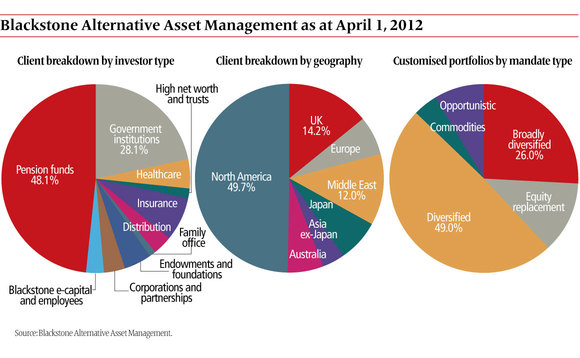
Once those guidelines are established, it is possible to construct a portfolio that is within the tolerances of those risk parameters. He admits it is possible to achieve higher returns by investing over a longer time period, “as long as you’re comfortable with the investment.
“Risk is the magnitude and probability of loss over a fixed time period and if your time period is six months, then you have to have certain liquidity standards. But if your time period is over three years, then it’s a very different proposition where you can take some marks as long as you’re comfortable that at the end of the three-year period the position will in fact be strong.”
One big risk on the horizon is the eurozone crisis. One of Baam’s scenarios for resolution of the crisis has northern Europe splitting off from southern Europe, creating a much stronger euro, rather than a weaker one. In fact Baam seems interested in the idea of several currencies coming back into play.
Whatever the outcome, Hill believes it is important to model how each manager’s positions are impacted by the different scenarios. “The biggest concern that we’ve had is if the banking system comes unglued, which appeared to be a real risk during the banking system crisis in 2008,” admits Hill. “We’ve taken steps to model out how various banks are going to react if there’s a series of runs on the banks in various countries.”
There is one scenario, says Hill, which is not part of the 16 but a subset where the European Central Bank plays god and simply designates some banks as survivors and the others simply fail. Such an outcome would have significant implications for any manager caught up in one of the bank failures.
Despite the various ways the situation could play out, Hill believes “it’s all fairly predictable in terms of where this is headed”. The question for him is at what point do markets force more aggressive action on the part of the governments.
“If you look at our current portfolios, our exposure to Europe is really small and in most [portfolios] that exposure is on the short side,” says Gavin. “What we’re more concerned about is if there was ever something really catastrophic in Europe, it would obviously impact on global asset prices and markets. At some time there will be a boiling point in Europe. We have the flexible capital to take advantage of opportunities that arise.”
The main concern, however, remains the interconnectedness of the global banking system and how any major change in Europe would affect that. The fear is that the contagion spreads to US banks, to Chinese banks and onward.
“We do monitor the situation in Europe closely. We’re regularly meeting with the banks and reviewing their exposure and how they do their own risk management. But currently our portfolios are not positioned with a lot of European exposure,” concludes Gavin.
Baam is not concerned just with the sovereign risk position of banks but also what corporate exposure they have. Hill says many banks have “significant exposure to these countries” through corporates and expects a “shake-off soon and at prices that we’re going to find very attractive”.
Whatever the future brings for Europe or the hedge fund industry, Baam should be well positioned to take full advantage of opportunities. Its concentration of client needs and real customisation should also continue to make it one of the most successful groups in future. How the rest of the FoHF sector will fare is an open question.
Only users who have a paid subscription or are part of a corporate subscription are able to print or copy content.
To access these options, along with all other subscription benefits, please contact info@risk.net or view our subscription options here: http://subscriptions.risk.net/subscribe
You are currently unable to print this content. Please contact info@risk.net to find out more.
You are currently unable to copy this content. Please contact info@risk.net to find out more.
Copyright Infopro Digital Limited. All rights reserved.
As outlined in our terms and conditions, https://www.infopro-digital.com/terms-and-conditions/subscriptions/ (point 2.4), printing is limited to a single copy.
If you would like to purchase additional rights please email info@risk.net
Copyright Infopro Digital Limited. All rights reserved.
You may share this content using our article tools. As outlined in our terms and conditions, https://www.infopro-digital.com/terms-and-conditions/subscriptions/ (clause 2.4), an Authorised User may only make one copy of the materials for their own personal use. You must also comply with the restrictions in clause 2.5.
If you would like to purchase additional rights please email info@risk.net
More on Fund of funds
FoHFs – shrinking without trace?
Funds of hedge funds are struggling to attract investment more than the funds they invest in

Funds of hedge funds look to focus and diversify both at once
Concentration on largest holdings has grown but average holding size has shrunk

Best bespoke FoHF provider: Amundi Alternative Investments
Clients want quick-moving funds as volatility creeps up, says Amundi

Best advisory team; Best HNWI/private client FoHF provider: Goldman Sachs Asset Management
AIMS' chief investment officer worries about a credit sell-off in 2016

Best specialist FoHF under $500m over three years: Ayaltis Narrapuno Spectrum
Spectrum fund profits from exposure to credit via market-neutral equities

Best seeder: Tages Capital
Tages offers new funds capital, advice and product ideas

Best managed accounts platform: Deutsche AWM
Deutsche AWM's platform has embraced arbitrage strategies that others have not

Best Ucits-compliant FoHF: Credit Suisse Prima Multi-Strategy Fund
Ucits funds still pose operational risks, says Credit Suisse
