

Hedge funds see opportunity in beaten-down commercial mortgage-backed securities
Commercial mortgage-backed securities (CMBS) offer attractive returns for investors prepared to ride out short-term volatility. The revival is driven by better than expected performance by legacy CMBS.

Commercial mortgage-backed securities (CMBS) are making a comeback after dying a death in 2008 when overleverage led to indiscriminate selling. The revival is driven by a new generation of leaner, meaner products and better than expected performance by legacy CMBS.
Those willing and able to exploit the opportunities created by an inefficient market with high barriers to entry and conservative ratings can benefit from attractive risk return metrics.
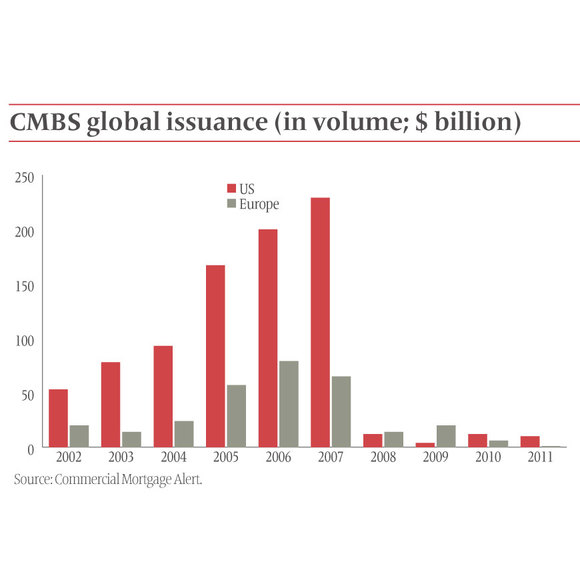
Between 2002 and 2007 issuance of CMBS in the US quadrupled to $229 billion and European issuance trebled to $65 billion. In 2007 total CMBS issuance was $300 billion. Some of the biggest trophy properties went down this route.
In their drive to quote competitively, providers offered increasingly aggressive terms. Underwriting and credit ratings relaxed and leverage increased as loan to value (LTV) ratios rose to 80%-100%.
|
Standard terms of a European CMBS loan |
|
|
|
CMBS loan standard terms |
|
Borrower type |
Special purpose vehicles (SPVs) |
|
Loan type |
Fixed rate or floating rate hedged at the borrower level 1 |
|
Loan term |
Typically medium (3-7 years) |
|
Financial covenants |
LTV, ICR/DSCR, cash trap triggers |
|
Release premium |
Upon asset sale, typically between 110% - 130% of ALA |
|
Substitution |
Not permitted |
|
Development |
Not permitted |
|
Other covenants |
Property manager Bank accounts Insurance |
|
Prepayment penalties |
May cover full life of the loan |
|
(1) Interest rate to be paid in full. No discounted interest rate methodology applies in CMBS loans. Source: Deutsche Bank |
|
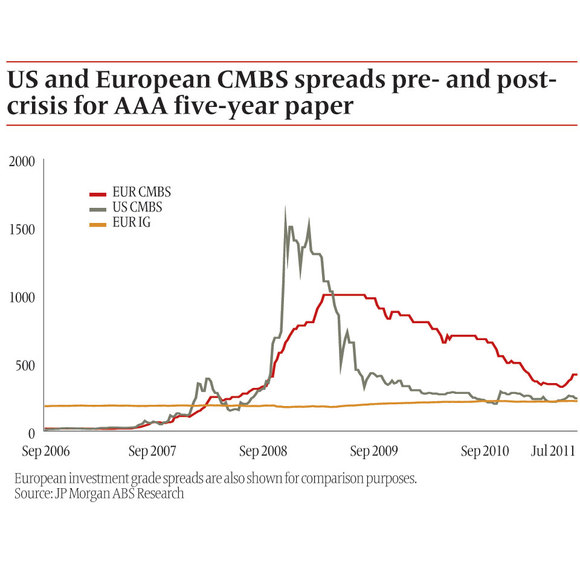
When the financial crisis hit, selling by highly levered investors became endemic and indiscriminate. European and US spreads blew out significantly. This was most exaggerated in the US, peaking at nearly 1,600 basis points (bp) in October 2008.
By November 2008 loss severity and delinquency rates were on a sharp upwards trajectory. The CMBS market all but dried up.
In late 2009 better than expected performance on vintage CMBS and the advent of CMBS 2.0 sowed the seeds of a comeback.
Two key changes had occurred: ratings and LTV ratios were much more conservative.
Previously, rating agencies had been too aggressive in their assumptions. The pendulum has now swung the other way. “They appear conservative and are also feeling empowered to withdraw or not rate deals,” says Ravi Stickney, portfolio manager at $6.8 billion Cheyne Capital. “Investors should look at CMBS for the simple reason that they are getting a truly outsized return for taking a conservative level of risk.”
LTV ratios have also come down, attracting new money into the market, including insurance companies in Europe. “They can get a nice juicy margin refinancing at 50%-60%, which is a good way to get a return,” according to Stephen Ashworth, manager of Reech CBRE’s $135 million Iceberg Alternative Real Estate Fund.
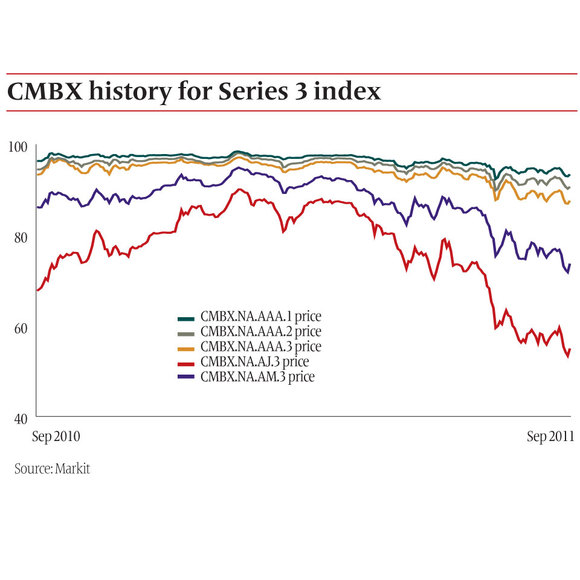
Consequently, the CMBS comeback picked up speed. Between September 2010 and February 2011, Markit’s CMBX indexes showed price increases across the board with the most exaggerated gains in the lower-rated AJ (the most subordinate of the AAA-rated tranches) and AM tranches (those that sit between the CMBX.NA.AJ and CMBX.NA.AAA tranches in the capital structure and were originally rated AAA).
“The concerns about CMBS in 2008 and 2009 have by and large proven unfounded. Borrowing has become cheaper as long-term swap rates hit an all-time low. Liquidations of assets have come down and refinancing has been quicker than anticipated, which increases the realised return,” says Stickney. “When we underwrote CMBS in 2009, we did so assuming a 13% IRR [internal rate of return] and a high level of defaults, significant losses and lengthy loan extensions. CMBS has, therefore, exceeded our expectations.”
Cheyne’s £303 million Real Estate Debt Fund is 67.9% exposed to CMBS (52.2% UK, 37% Europe) and is up 8.1% at August 31 compared with a negative 4.7% for the iTraxx Crossover Total Return Index (European high-yield credit) and a drop of 17.6% for the EuroStoxx 50.
By May an S&P report showed loss severity rates down significantly at 37%, after hovering between 50%-60% in 2009 and 2010. It pointed to lower future rates based on improving property fundamentals, expanding debt issuance, speedier loan resolutions and the expectation collateral cash flows would continue improving.
Then came summer.
CMBS weakened in line with credit markets, causing many to make mark downs. From June toAugust the price trend for the Markit CMBX indexes reversed, with the AJ and AM series booking 9% and 24% declines respectively.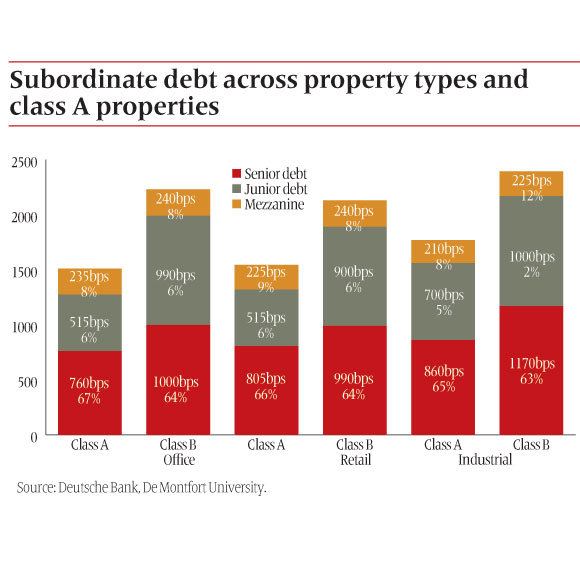
In July investor confidence was badly hit when S&P pulled ratings on several deals because it discovered “potentially conflicting methods” in its rating system. Goldman Sachs and Citigroup were forced to cancel a $1.5 billion CMBS deal.
“Over the past few months, capital markets participants have become concerned over the viability of CMBS to provide commercial mortgage financing after witnessing the “priced” Goldman/Citi new issue being withdrawn”, says Darrell Wheeler, CMBS strategist at Amherst Securities Group. “The resulting volatility has been very hard on the market with many participants looking back to 2008 conditions and wondering what could stop the falling knife of 2011.” By the end of August one in six European CMBS loans was in special servicing and one in eight was in default.
Barclays Capital reported a decline in the delinquency to “cure” rate from 6% to 3% in September. “The decline in the cure rate is partly because refinancing is harder to secure, which is partly because real estate prices have come down so borrowers have less equity to post and fewer new loans are quoted by conduit lenders,” according to Julia Tcherkassova, mortgage-debt analyst at BarCap.
As European banks continue to suffer, 32 loans will mature in October according to S&P figures, the highest concentration in 2011. One-third are already showing signs of pressure.
Uncertain volatility
New issuance is again facing an uncertain future.
“Markets are so volatile, conduit originators are having a hard time determining the execution levels where bonds will sell. Therefore quoting new loans is challenging. If the pipeline decreases there will be fewer possibilities for borrowers to refinance and, therefore, a pick-up in delinquencies,” says Tcherkassova.
“Fifteen months ago around 60% of loans were still outstanding three months after their maturity date. That ratio dropped to 35%-40% by July as more loans were able to refinance. We may see an increase in the ratio in early 2012 if the level of new issuance does not pick up. That will put additional pressure on spreads,” she adds.
By September 27 CMBS prices showed annual declines, with AJ and AM tranches seeing the most substantial falls of 22% and 39% since their mid-February peak respectively, and 15% and 19% since 27 Sept 2010.
“A few brave CMBS investors have tried to call the market bottom as evidenced by some buying of CMBS AM and AJ bonds while our CMBS ALIAS loss and yield projections suggest a second economic downturn is now priced in after the recent dislocation,” says Amherst’s Wheeler.
Cheyne’s Stickney is one such opportunist. “We are looking for very strong credits with short duration at yields far in excess of the risk they entail. Selling is still indiscriminate between good and weak products. We are able to buy the most senior CMBS layers with 50% LTV for duration of two years at yields of around 13%. These opportunities are better than anywhere else in corporate credit,” he says.
Scott Gibb, portfolio manager for Cube Capital’s $700 million flagship Global Multi-Strategy Fund, down 1.41% for the year at August 31, is also looking to increase exposure to CMBS over time.
“Looking over a five-year period, constant default rates have rarely gone above 7% even through severe downturns,” he says. “Prices are attractive today with prices for second and third pay tranches priced in the 50-60s offering mid-teens type returns, even with conservative assumptions,” Gibb continues.
“In 2008 structured credit suffered significant losses as prices spiralled down with highly leveraged players all seeking to unwind simultaneously. Today there is a floor to prices as the market has little to no leverage with real buyers willing to add exposure at the right levels.”
However, in the short term investors need to be able to sustain a high level of volatility despite attractive prices, particularly on AJ tranches and below.
“Buying at 20c/$ is very attractive, but that doesn’t mean it is not going to be worth 10c/$ tomorrow,” warns BarCap’s Tcherkassova. “Those willing to hold these tranches should see a decent return. Even in the AM space most tranches are 20% supported, which means 40% of the loans can default and be liquidated with 50% severity before the holder sees a loss. Those imply an average yield of 8% for a highly protected tranche. That looks attractive, but the question is whether investors can sustain the volatility.”
Spreads on US and European CMBS have compressed 86% and 59% respectively since their peaks. European spreads have been consistently wider since April 2009, reflecting the differing natures of the two markets. The European market is less standardised with differing LTVs, amortisation schedules, hedging, mortgage security and asset classes.
European opportunities
As a result many hedge fund managers believe Europe presents the best opportunity at present.
“The opportunity in the European CMBS market is greater than that of the US because the inefficiencies are greater,” says Cheyne’s Stickney. “Spreads on AAA CMBS in Europe are around 700bp to 800bp, up to four times that of the US.”
Successfully investing in CMBS requires a thorough knowledge of the real estate fundamentals, real estate lending and high-yield bond mechanics. “That skillset is still lacking in Europe,” Stickney adds.
European CMBS also tend to have only three to five loans in each issuance creating a better opportunity to understand each underlying asset compared with the US, where each issuance may contain up to 200 real estate loans.
According to Reech’s Ashworth, there are some attractive returns available, particularly in the UK where it is possible to get top-tranche instruments with low LTV ratios. “These have a rock-solid ability to refinance and offer returns 600bp-800bp above Treasuries,” he says.
“However, it is important to understand this is not characteristic of the whole market. During the last 18 months, some of the lower tranches of the bigger issuances have been bid up to levels that are considerably overpriced,” continues Ashworth.
“There are some very dangerous spots. Since 2007 there has been a lot of dispersion in how the different instruments have performed and investors need to be careful they are looking in the right areas and understand the way the deal is structured and the underlying real estate,” he adds.
The Iceberg Alternative Real Estate Fund is 10% invested in CMBS and has produced a return of 1.18% in US dollar terms for the year to the end of August (7.31% 2010, 17.78% 2009).
Ashworth remains bullish on the outlook for real estate. “In a low-growth world, stable income becomes very attractive, even more so when real interest rates are negative, which will be a strong driver of demand for real estate,” he says.
As yields on Treasuries and European safe haven sovereign bonds continue to hit new lows and real interest rates remain negative, investors are expected to see even greater value in CMBS spreads that still provide one of the highest AAA-rated yields available above 3%.
“As much as CMBS was decried during the crisis, the structures have generally been quite resilient. As the major issues in the eurozone get resolved, people will be looking to buy quality yield, and at the current levels, CMBS is quite attractive,” says Cube Capital’s Gibb.
“We expect this paper to make a decent return of around 15% or more given yield and expected capital gains as buyers bid the paper up over the coming few years. The market is still quite tight and in order to load up at the right prices, you have got to be very active to get what you are after rather than waiting for it to come to you,” Gibb adds.
|
Comparison of European and US loans |
|||
|
|
European loans |
US fixed rate loans |
US floating rate loans |
|
Coupon |
Fixed and swap |
Fixed |
Floating |
|
Term |
3-7 years |
7-10 years |
2-5 years (plus extensions) |
|
Prepayment penalties |
Light prepayment penalties, usually 2-3 years |
Defeasance |
Light prepayment penalties, usually 2-3 years |
|
Financial covenants* |
LTV, ICR/DSCR, cash trap triggers |
No |
Not commonly featured |
|
Collateral |
Mostly stabilised |
Stabilised |
Transitional |
|
Recourse |
Non-recourse |
Non-recourse |
Non-recourse |
|
Bad boy carve-outs |
No |
(i) fraud, (ii) gross negligence and (iii) misappropriation |
(i) fraud, (ii) gross negligence and (iii) misappropriation |
|
Source: Deutsche Bank. |
|||
Only users who have a paid subscription or are part of a corporate subscription are able to print or copy content.
To access these options, along with all other subscription benefits, please contact info@risk.net or view our subscription options here: http://subscriptions.risk.net/subscribe
You are currently unable to print this content. Please contact info@risk.net to find out more.
You are currently unable to copy this content. Please contact info@risk.net to find out more.
Copyright Infopro Digital Limited. All rights reserved.
As outlined in our terms and conditions, https://www.infopro-digital.com/terms-and-conditions/subscriptions/ (point 2.4), printing is limited to a single copy.
If you would like to purchase additional rights please email info@risk.net
Copyright Infopro Digital Limited. All rights reserved.
You may share this content using our article tools. As outlined in our terms and conditions, https://www.infopro-digital.com/terms-and-conditions/subscriptions/ (clause 2.4), an Authorised User may only make one copy of the materials for their own personal use. You must also comply with the restrictions in clause 2.5.
If you would like to purchase additional rights please email info@risk.net
More on Strategy
CTAs beat hedge fund rivals in 2014
Investors hope that CTAs’ fortunes have changed for good

Multi-strategy hedge fund assets surpass $400 billion
Investors flock back to strategy after years of trickling inflows

Hedge funds cautious on Argentina
How might hedge funds take advantage of opportunities in Argentina?

Hedge funds face growing risk, technology and data challenges
Sponsored feature: Broadridge Financial Solutions

A promising future
Sponsored statement: NYSE Liffe

Government bond traders see difficult markets heading into 2014
Your word is my bond

Hedge funds increase Asia quant investing risk capital by 50%
An improved Japan economy is ramping up quant investor activity across Asia

CTA trend followers suffer in market dominated by intervention
Return to normality
