The risks of E&P
After two years of soaring oil prices, oil majors are still building low oil-price forecasts into future investment plans. Is this sound risk management, or are they being too risk averse? By Stella Farrington
While US crude futures have averaged over $50 a barrel so far in 2005, most oil majors are still using a price estimate of around $25 a barrel for assessing whether a potential new E&P project will be profitable.
As a result, many of today’s potential projects – most of which are in expensive deep water or technically challenging areas – are deemed simply not economically viable. Setting the hurdle at half of today’s actual oil price prevents many new projects from going forward. And of course, without new supplies of oil coming to the market, tight market dynamics and high prices are likely to remain a feature for some time.
Many analysts are now asking whether the oil majors are being too risk averse.
BP’s chief executive Lord Browne recently said he expects oil prices to remain above $40 a barrel (/bbl) for the next five years. Yet BP sets its project ‘test’ figure at $20/bbl, according to a spokesman. Total has an informal figure of around $25/bbl, and ChevronTexaco has recently raised its figure to $20-$30/bbl from $15-$25/bbl.
Of course, assuming that oil prices will stay at current levels for the duration of a long-term E&P project would be far too risky. But when few analysts are predicting a move much below $40/bbl in the next two to three years, setting a hurdle of $25/bbl could be seen as taking prudence to extremes.
“I’ve been fascinated by the fact that the oil majors haven’t made more investments in drilling,” says Susan Fulton, founder and principal at WealthTrust FBB, a US-based fund with of $5 billion of assets under management. “They either believe it’s not there, or that it’s not there at a price that’s economical for them to extract it,” she says.
Publicly the oil majors express the opinion that they believe current prices are an aberration and that they will fall again. Oil executives that remember the difficult times of the 1990s, the end of which saw prices at under $10/bbl, are reluctant to believe in long-term prices above $50/bbl.
New projects can also take decades, and forecasting prices out this far is impossible, they say. “New projects have a lifetime of 20 to 30 years, so you have to take a very conservative view,” says the BP spokesman. “Look at what happened in the 1990s.”
Fear of shareholder reprisal if a project is still loss-making past the predicted profit-making deadline also breeds prudence, analysts note.
“The litigious nature of business today encourages people to be prudent,” says Fulton. “Better to be prudent and not start work on a project, than start work, find the oil price drops and that the project is losing money. If they predict a low price there is a lot less likelihood they will be faulted than if they pick a higher price.”
However, what the oil price does is only part of the story. Working out whether a project is economical requires more complex modelling analysis than ever before. Most of today’s projects are technically challenging and costly, carry a high level of political risk and are carried out in host countries under production sharing contracts (PSC).
“Today’s new deep-water projects require huge upfront investment, which blows out the old risk profile models,” says Malcolm Butler, who also advises companies on E&P projects in West Africa as a consultant with London-based financial services firm Seymour Pierce. “The expected monetary value [EMV] of projects has been lowered significantly because exploration drilling costs have doubled.”
It typically costs around $2–$3 billion to develop a field in deep water in offshore West Africa, and around six to 10 years before oil is first pumped. The cost of drilling a well is now around $45–$50 million compared with $20–$25 million just a year ago, Butler says.
“Drilling for oil is a much bigger and more long-term investment than most projects,” notes Fulton. “With tar sand and shale, a high price is required, but if the price drops, you can stop digging. If you’re drilling a deep well it’s a huge upfront cost of capital with no return for some time. If you need a $45-a-barrel oil price for your project to be profitable, you’ll need it to stay at $45 for a long time. If you drill in the Gulf of Mexico and it isn’t profitable for the first and second years, and then there’s a hurricane, you’re obviously in trouble.”
Butler agrees: “The problem with deep water is that you can’t get any early production,” he says.
But, perhaps more importantly, now that most of the home-soil oil in North America and Europe has been exploited, almost all new oil projects are carried out overseas, often in the Third World, and are conducted under a production sharing contract between the oil major and the host government. PSCs are used in almost all new areas, most notably for the deep-water, offshore West Africa fields and the Caspian Sea projects.
Under the terms of most PSCs, the oil major agrees to receive a percentage of the oil from the project, which reduces once the company has recovered its costs and reduces further once it passes certain profit levels. Therefore, when the oil price increases the number of barrels required to recover costs reduces, as does the number of barrels required to pass the profit hurdles. Although a project’s reserves may have been booked, if the oil price goes up, the major will take ownership of fewer barrels than before. So its oil reserves will actually go down when the price rises. In addition, although it would get some upside profit from the higher oil price, the state oil company would benefit the most.
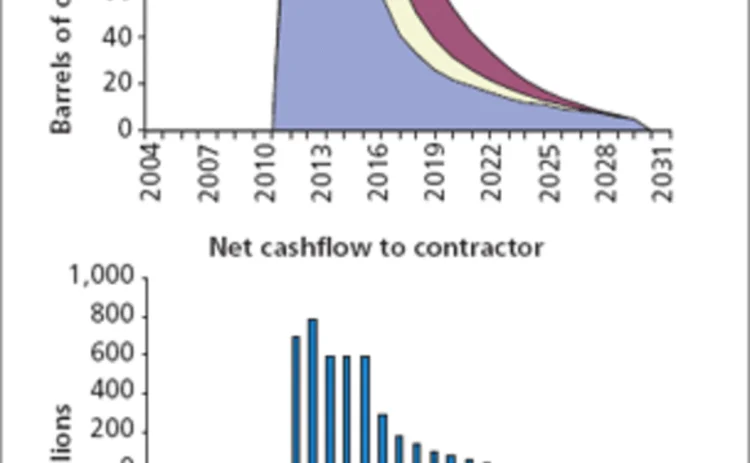
Butler has run a model (see figure 1) demonstrating what happens to the contractor (the major) and the government oil company in the development of a 500-million barrel oil field under a typical deep-water West Africa PSC when the oil price rises from $20/bbl to $50/bbl. With a $20/bbl oil price, the government would take $3.77 billion, which increases to $16.28 billion at $50/bbl. The contractor, on the other hand, increases its take from $2.16 billion to only $4.55 billion.
This explains why the recent price rise from $20/bbl two and a half years ago to the current $60/bbl is not nearly such a cause for excitement as it might seem for an oil major working in West Africa. “Higher oil prices are not the bonanza it seems if you work under a PSC,” notes Butler.
Once the real cash-cow for big oil, E&P is fast becoming the struggling arm behind the now-booming refining businesses.
In fact, in order to enter projects that have the potential to contain large reserves, oil companies are having to resort to taking more financial risk upfront because shortage of equipment has greatly increased costs. In order to save on costs it is now becoming common for companies not to run expensive production tests on discovery wells, instead relying on well log and core analysis and simply moving ahead with the rest of the project, leaving testing to later appraisal wells.
With the higher cost of projects, less scope for making big profits, and shareholders’ insistence on earnings growth, oil majors are in an increasingly uncomfortable position, some analysts believe.
And the under-investment in E&P now seems to be showing. In 2004 companies reported very low reserves replacement compared with previous years, when reserve replacement has traditionally been over 100% of production. In 2004 Chevron reported oil and gas combined reserve replacement as 18% of production. For Shell the figure was 25%; BP reported 89%, but much of that was in acquisitions in Russia; and Exxon reported 89%, but the bulk of that was gas reserves booked in Qatar for new liquefied natural gas (LNG) and gas-to-liquids projects. Stripping that out, Exxon’s reserves additions were 18%.
“I personally think we have some real issues here,” comments Fulton. “Some of the majors are using the ostrich approach. I personally feel more comfortable with companies that are diversifying into other fuels,” she adds.
“There will come a time when the majors have to admit that they can’t sustain their upstream business,” says Butler. “Traditionally this is where they’ve made their money. The market rates their upstream businesses as going concerns based on the assumption that they can continue to replace their reserves.”
An interesting success story in a declining production scenario has been Canada’s Royalty Trusts, notes Butler. “The Royalty Trusts in Canada are an acceptance that the business isn’t growing,” he says. Under this model, reserves are put into a trust, there’s no re-investment in trying to find more reserves and all the profits from production are distributed to the unit holders in a tax-efficient manner.
It would appear increasingly that the only companies expanding in oil production are the government-run oil companies, particularly in the Middle East.
“I think the world’s oil business will continue the trend of the last 25 years – it will be increasingly carried out by state oil companies,” says Henry Groppe, of Houston-based oil consultancy Groppe, Long & Littell.
“And these companies don’t need the multinationals,” he adds. “True, the state oil companies don’t have all the skills of the multinationals, but they can hire service companies such as Halliburton and Schlumberger who do have the necessary expertise. They can also hire private consultants who have probably worked for oil companies on these sorts of challenges for years,” he says.
The next logical move would probably be an oil major buying a large oil services company, notes Butler.
If there is a growth story for the majors, it will most likely be in the LNG and gas-to-liquids markets, where they have unique experience, says Groppe. Refining will also continue to be a big part of their businesses. “Exxon, for example, runs the biggest logistics system in the world,” he says. “It only produces half the crude it refines – the rest it buys.”
Only users who have a paid subscription or are part of a corporate subscription are able to print or copy content.
To access these options, along with all other subscription benefits, please contact info@risk.net or view our subscription options here: http://subscriptions.risk.net/subscribe
You are currently unable to print this content. Please contact info@risk.net to find out more.
You are currently unable to copy this content. Please contact info@risk.net to find out more.
Copyright Infopro Digital Limited. All rights reserved.
As outlined in our terms and conditions, https://www.infopro-digital.com/terms-and-conditions/subscriptions/ (point 2.4), printing is limited to a single copy.
If you would like to purchase additional rights please email info@risk.net
Copyright Infopro Digital Limited. All rights reserved.
You may share this content using our article tools. As outlined in our terms and conditions, https://www.infopro-digital.com/terms-and-conditions/subscriptions/ (clause 2.4), an Authorised User may only make one copy of the materials for their own personal use. You must also comply with the restrictions in clause 2.5.
If you would like to purchase additional rights please email info@risk.net
More on Energy
ETRM systems 2024: market update and vendor landscape
This Chartis report evaluates energy trading and risk management systems that provide front-to-back, asset class-specific and geography-specific coverage, and considers the full energy trade lifecycle

CTRM systems 2024: market update and vendor landscape
A Chartis report on commodity trading and risk management systems that considers its different applications and addresses the market and vendor dynamics to determine the long-term and structural impacts of the overarching market evolution on the…

Energy Risk Commodity Rankings 2024: markets buffeted by geopolitics and economic woes
Winners of the 2024 Commodity Rankings steeled clients to navigate competing forces
Chartis Energy50
The latest iteration of Chartis’ Energy50 ranking

Energy trade surveillance solutions 2023: market and vendor landscape
The market for energy trading surveillance solutions, though small, is expanding as specialist vendors emerge, catering to diverse geographies and market specifics. These vendors, which originate from various sectors, contribute further to the market’s…

Achieving net zero with carbon offsets: best practices and what to avoid
A survey by Risk.net and ION Commodities found that firms are wary of using carbon offsets in their net-zero strategies. While this is understandable, given the reputational risk of many offset projects, it is likely to be extremely difficult and more…

Chartis Energy50 2023
The latest iteration of Chartis' Energy50 2023 ranking and report considers the key issues in today’s energy space, and assesses the vendors operating within it

ION Commodities: spotlight on risk management trends
Energy Risk Software Rankings and awards winner’s interview: ION Commodities