Accounting for concessions
International Container Terminal Services has expanded its operations across the globe. Treasurer Rafael Jose Consing tells Asia Risk how the company manages risks and discusses the impact of new accounting rules for concessions. By Georgina Lee

Philippines-based International Container Terminal Services (ICTS) has established itself as an acquisitive international container terminal operator following a decision by the company's management in 1994 to expand out of its home base where it runs the Manila International Container Terminal.
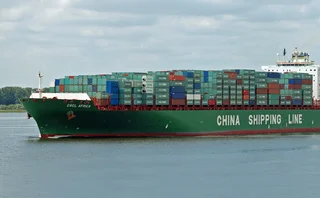
ICTS last year handled 3.73 million twenty-foot equivalent units (TEUs) and the company is now operating container terminal ports in 11 countries, including Brazil, China, Poland and Madagascar.
This increase in international activity has meant foreign exchange has become a major risk for the performance of the company alongside interest rate risk linked with its floating rate debt. In a bid to cushion against that volatility, ICTS's management last year took a significant step by securing regulatory approval to switch the group's functional currency to the US dollar from the peso at the start of this year.
As at end of 2008, 49% of the group's total revenue of 20.6 trillion pesos ($436 million) was denominated in US dollars, with the remaining exposures largely in euro, Philippines peso, rupiah, renminbi and zloty. "Our primary approach to managing currency risks is to hedge ourselves operationally," says Rafael Jose Consing, Manila-based treasurer at ICTS. "This means trying to achieve within our concession and service agreements a 50/50 distribution between local currency and US dollars (or euro), for both revenues and expenditures ... And the net exposures that we cannot hedge naturally (or operationally) are squared off in the derivatives market."
As at end-2008, ICTS maintained an 80:20 floating to fixed rate ratio on its PHP20 billion ($420 million) long-term debt. At today's levels, the company has begun fixing the interest on some of its long-term liabilities via interest rate swaps.
When accessing the derivatives market, Consing says his team prefers perfect cashflow hedges, so as to reduce volatility in ICTS's profit and loss account. "Our financial hedging transactions consist only of plain vanilla forwards and options," he says.
Service concessions are arrangements whereby a government or other public sector entity grants contracts to private sector operators that offer public services ranging from roads, airports, prisons or energy to water supply and distribution facilities over a period of time. And these arrangements are now treated differently under International Financial Reporting Standards (IFRS).
Consing says ICTS actively took the decision to become an early adopter of the new accounting principles issued by the International Financial Reporting Interpretations Committee (IFRIC) in November 2006. These rules, called IFRIC 12, are aimed at more accurately valuing container port businesses.
Companies using IFRIC 12 are now required to recognise the present value of their fixed committed concession fee payable to the port authorities of the respective countries they operate in as a liability during the life of the concession. "The effect on your balance sheet is as if you have borrowed that amount of present value, as opposed to prior to the accounting change; you just expense out your concession fee every year on your profit and loss account," Consing says.
Previously concession-based businesses were valued only according to the book value of the largest items on a balance sheet, which tended to be property and equipment - but a concession contract tends to have a much higher value compared to equipment that does not contribute to revenue. "From an accounting point of view, if you don't have the concession, even if you have the crane and container forklifts, this equipment is worthless," says Consing.
Consing says ICTS has applied the IFRIC 12 changes to its 2008 financial year. As a result ICTS has a higher debt-to-equity ratio due to recognition of the fixed concession/fee as part of its liabilities. But such higher gearing has not affected its cost of debt, Consing says.
ICTS plans to continue with its strategy to run end-destination container terminal ports in import-driven economies. But Consing sees new opportunities. "Some of the port acquisitions led by private equity and those acquired by shipping companies may eventually unravel due to liquidity constraints and near bankruptcy," says Consing. "We believe that acquisition opportunities could result from potentially distressed sales. It is these situations in particular that we are closely monitoring."
Only users who have a paid subscription or are part of a corporate subscription are able to print or copy content.
To access these options, along with all other subscription benefits, please contact info@risk.net or view our subscription options here: http://subscriptions.risk.net/subscribe
You are currently unable to print this content. Please contact info@risk.net to find out more.
You are currently unable to copy this content. Please contact info@risk.net to find out more.
Copyright Infopro Digital Limited. All rights reserved.
As outlined in our terms and conditions, https://www.infopro-digital.com/terms-and-conditions/subscriptions/ (point 2.4), printing is limited to a single copy.
If you would like to purchase additional rights please email info@risk.net
Copyright Infopro Digital Limited. All rights reserved.
You may share this content using our article tools. As outlined in our terms and conditions, https://www.infopro-digital.com/terms-and-conditions/subscriptions/ (clause 2.4), an Authorised User may only make one copy of the materials for their own personal use. You must also comply with the restrictions in clause 2.5.
If you would like to purchase additional rights please email info@risk.net
More on Corporates
Credit where it's due
IFRS 9 sweeps away centuries-old accounting conventions; banks look to frontload capital hit

Indian corporates count forex losses from rupee depreciation
Living on the hedge

Corporate cash seeks new home as money-market reforms loom
New regulation on both sides of the Atlantic threatens to make money-market funds less attractive for corporate treasurers. Banks are hoping this cash will flood into fixed-term deposits instead, helping them meet incoming liquidity ratios, but they’re…

Risk 25: How Basel III is turning borders into barriers
Turning borders into barriers

Treasurers highlight unintended consequences of regulation
Corporate treasurers complain about the unintended consequences of the proposed financial transaction tax, as well as clearing rules for OTC derivatives

Corporate backlash on costs of regulation continues
Banks will not be able to avoid passing on the hefty costs of regulatory reform to their buy-side clients, argued participants at the ACI UK’s annual square mile debate

Prepare for further black swan events in FX, corporates told
Corporate treasurers should make sure their forex counterparties are properly prepared for the possibility of further black swan events in the foreign exchange markets, senior Lloyds banker tells ACT conference delegates in Manchester

Corporate profile: Containing risk at China’s CSCL
Containing risk