Extraterritoriality, uncleared margin and futurisation – Isda on OTC derivatives reform
The first clearing mandates came into force in the US on March 11, but there is still plenty of uncertainty about how certain parts of the new regulatory framework will function. In this roundtable discussion, Nick Sawyer talks to two senior board members from the International Swaps and Derivatives Association about the clearing mandates, extraterritoriality and uncleared margin rules
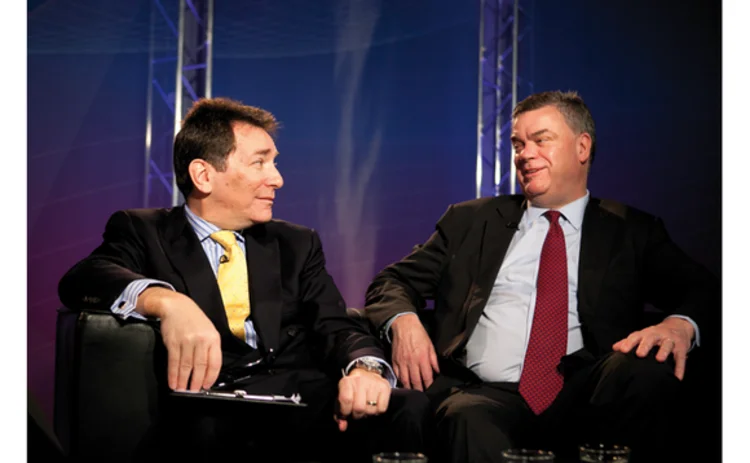
The Panel
Nick Sawyer, editor-in-chief, Risk
Stephen O'Connor: Chairman of the International Swaps and Derivatives Association and a managing director at Morgan Stanley
Eric Litvack: Vice-chairman of Isda and head of regulatory strategy at Société Générale Corporate & Investment Banking
Risk: The first clearing mandates under the Dodd-Frank Act came into force on March 11, capturing swap dealers, major swap participants and active funds. Were there any issues in the approach to this deadline?
Stephen O’Connor: There have been two things going on. There has been the run-up to the first wave of clearing and then there has been the documentation effort that needed to be done in the first quarter of 2013. That first wave captures the active market participants – the more sophisticated counterparties. Given that it is now a couple of years since the Dodd-Frank Act was passed into law, most of those entities have been working towards clearing for quite a long time. Dealers that provide clearing services have been working with their clients to help get them ready and those dialogues have been ongoing for a long time. While there may have been a bit of a rush at the end, most participants will have been ready. If they’re not, then it will be illegal for them to trade those products beyond the date under the clearing mandate. So I don’t see any real disruption to markets because of the first clearing mandate.
With regard to signing up to the protocols that cover all the documentation changes, that is a heavy lift. It is compressed into quite a short time frame, and banks and their clients have been working feverishly to get signed up. There may be a last-minute rush and some people may get it wrong, but there shouldn’t be too much disruption.
Risk: Have there been any bottlenecks?
Eric Litvack: Yes, there have been, and there will continue to be. The first wave has gone smoothly because it concerns the most active dealers and clients, and the most active subset of products. It will be more complex as it spreads out into a wider population of smaller, less active counterparties, not all of which will be ready. They need to review their documentation and they need to ensure they have clearing facilities set up. That will be challenging, particularly for the smaller counterparties, because it’s going to require capital at the clearing member or futures commission merchant level.
There is a risk that the increased margin requirements at that time might not be affordable for particular institutions, causing major liquidity issues or even bankruptcy
Risk: As of March 7, there were just two entities that had provisionally registered as major swap participants – one of the groups that are captured by the first wave of mandatory clearing. One is a credit derivatives product company and another is a monoline. Both are in run-off mode and neither has put on any new trades over the past few years. Are they what regulators were trying to capture?
Eric Litvack: Companies that are in run-off mode are not the prime candidates for that category. We’ve always felt the number of counterparties that would register as major swap participants would be low, and there had been talk of there being none. Those two that have registered are perhaps being a bit overzealous, but then they know their own numbers better than we do. The other possible candidates are still probably reviewing the numbers and ensuring they are captured before they self-certify. All of this points to another issue indirectly, which is that we have a vast corpus of new rules and there is not, at this stage, a common understanding of what they mean, which is creating a significant amount of regulatory uncertainty.
Risk: One area of uncertainty relates to the definition of ‘US person’. The Commodity Futures Trading Commission (CFTC) has published a variety of definitions over the past six months. What impact has this had on preparations?
Stephen O’Connor: The issues stem from uncertainty. In the second half of last year in particular, there were a lot of people scratching their heads and asking whether they were a US person or not. The CFTC took action in December to give some clarity, and also gave more time, which was helpful. With a bit more guidance, I’m hopeful we’ll get to the right place and give participants the clarity they need.
Risk: That action in December was an exemptive order that runs out in July, and which sets out a simplified definition of US person. However, the CFTC simultaneously published further proposed guidance, which suggested alternative definitions that will broaden the scope of US person. Would you prefer US regulators to stick with the simplified definition they are using now?
Eric Litvack: Absolutely, as there was some disruption to the market because of the earlier definitions of US person. In early October last year, when market participants had to start counting their volumes to establish whether they would have to register as swap dealers or not, a number of non-US banks and clients started shying away from doing business with US banks out of concern it would somehow capture them within the scope of US person. Some of the definitions of US persons that we’ve seen have been very expansive in their scope. A narrower interpretation of US person and a broader recognition of cross-border regimes in equivalency would get us to a more comfortable place.
Stephen O’Connor: Picking up something Eric mentioned in terms of disruption to markets, the CFTC has this requirement for dealers to register as swap dealers, which is unusual – it certainly doesn’t happen in Europe or most Asian markets. That requirement for overseas dealers to register with the CFTC once they get to a certain level of swaps transacted with US persons has caused market disruption. There’s real evidence non-US banks have stopped trading with their US bank counterparties in the interbank market and also with their US clients, which is harmful to market liquidity. Getting a good outcome on these cross-border rules, together with the rules on initial margin, are the two most important things as far as Isda is concerned.
Risk: A no-action letter was published in October, which was followed by the December exemptive order, to try and avoid that disruption, but has that worked? Are non-US entities trading now as before? Or is there still some concern about what will happen at the end of the exemptive order, causing people to be reticent.
Eric Litvack: There’s quasi-normality now. The disruption in October was addressed quickly by the US regulators, which provided more clarity and flexibility on what would and wouldn’t be classified as US business. If we don’t see any progress or any further clarity as we approach the deadline for the exemptive order, then there will be a reluctance to trade.
Stephen O’Connor: There is still this problem associated with the dealer registration. So there are non-US banks that will not trade with US banks, either because of their unwillingness to breach any threshold for having to register themselves in the US as a swap dealer, or for fear of being captured by other aspects of Dodd-Frank. They’d just rather not expose themselves to those requirements.
Risk: We’ve touched upon this concept that firms need to register as swap dealers if the aggregate notional volume of swaps traded with US persons breaches a de minimis threshold of $8 billion. The CFTC has released a variety of rules over the past six months governing which affiliates must be included when aggregating the swaps notional – and each one has been very different. What issues does this pose for globally active banks?
Stephen O’Connor: It’s challenging, particularly because in different jurisdictions – and even within jurisdictions – institutions have different ways of arranging their legal entities for various reasons, so each time there’s a change in these types of rules, it just kicks off another project to determine what the impact will be as far as that institution is concerned.
Eric Litvack: Most dealer firms have registered their principal dealing entities, certainly their US dealing entities, and in some cases their overseas dealing entities. Depending on the interpretation of how aggregation should take place, there is a risk that some entities within the group that are objectively not terribly active could still get captured. If a bank is active in the US and has a branch in Malaysia that does a small amount of local currency business and occasionally faces some US clients at their request, then it’s not useful to register them. It’s an enormous operational burden in transposing compliance, reporting and training to the local entity. The likely outcome if some of those entities are captured is simply that, to avoid the barrier to entry, they’ll cease that business or they’ll cease it in that form. Maybe they’ll redirect some of the business they traded locally to the US registered entity, or maybe they’ll simply decide it’s just not worth serving those clients, and so they’ll either just pull out of that part of the market or that part of the market facing US clients.
Risk: That’s a huge decision for firms to make, isn’t it?
Eric Litvack: It’s an enormous transition, which is why I’d say it is an easy decision in many respects. The world has changed – bank capital is much more expensive and the hurdle rate for business is that much higher. If you are going to lay a significantly higher regulatory burden on a branch or subsidiary based somewhere in southeast Asia simply because it has the occasional US client, then it’s almost a no-brainer to shut off the US client from that business because the additional revenues you’d get from the occasional US client would never recoup the additional investment you’d need to make in terms of the overall compliance burden. It would be the wrong decision from a global market efficiency perspective, but the right decision for shareholders.
Risk: I want to touch on this concept of substituted compliance. The CFTC proposed in June last year that foreign branches of US banks and non-US swap dealers would be able to apply the rules of the local jurisdiction, as long as those rules are equivalent to Dodd-Frank. The exemptive order pushed that aside and allowed those entities to apply the local rules regardless. As we’ve discussed, that exemptive order finishes in July. It seems pretty certain that the European Market Infrastructure Regulation (Emir) won’t be fully operational in Europe by July. What does that mean?
Stephen O’Connor: The reason for that delay was to give the international regulatory community more time to get to these issues. There is a willingness on all sides to get to a good outcome. There are challenges – namely, that Dodd-Frank is the law and the CFTC and the Securities and Exchange Commission have to implement rules to comply with the law. To a degree, regulators’ hands are tied. International regulators have been meeting; there was a public meeting in Washington, DC in December and there was a universal wish to get to the right outcome. Emir won’t be finished by July, but with further co-operation and perhaps further exemptive relief, we will get to the right place.
Eric Litvack: Will Emir be totally in place by the end of the exemptive order? No, but I don’t think it was ever going to be, and I don’t think that was necessarily the endgame of the exemptive order. We know fairly clearly where Emir is going to be – it has been European law since last August. There are a number of regulatory technical standards already in place. We know roughly, to within a few months, when each of the obligations will start biting. If Emir was in place today, then it wouldn’t change the need for the exemptive order, because the order was not about making sure there was another regime in place – it was about making sure that supervisors had agreed on a framework to recognise each other’s regimes.
Risk: Now that we have some understanding of exactly what is going to be required in Emir, what are the differences between the regimes in the US and Europe that concern you most?
Eric Litvack: There are differences in the way some of the obligations are implemented, but that is not necessarily problematic. It’s clear there are differences in the implementation timetable for the trading obligation, but that will come. It’s under way in Europe within the Markets in Financial Instruments Directive, although it’s not advancing as quickly as in the US. The fact there are slightly different timetables for reporting, record-keeping, confirmation, clearing, compression and so on – I don’t see that as being the primary issue.
The primary issue is cross-border recognition – the concept that supervisors are willing to recognise there is an equivalent process elsewhere. It shouldn’t make that much difference that the clearing obligation is framed slightly differently, nor that reporting and record-keeping are done in a slightly different manner. The issue is, are the big boxes ticked and are they getting to the same place? We’re comfortable that – on both sides of the Atlantic and in parts of Asia – we are getting there. The issue is, how do we make it all work together and how do we recognise that what is happening for a given transaction in Europe satisfies US regulators, and vice versa?
Risk: A set of proposals on uncleared margin was published by the Basel Committee on Banking Supervision and the International Organization of Securities Commissions in July 2012, and another near-final set of rules was published earlier this year. There are some quite significant changes in the latest version, including thresholds and exemptions. Have the changes addressed industry concerns that the uncleared margin rules would lock down a massive amount of collateral?
Stephen O’Connor: The second set of proposals goes some way to relieving some of the concerns we had, but many remain. Thresholds are tools that the regulators can use to make the initial margin regime more affordable or to reduce the impact on liquidity in markets. The proposal moved to recommending the maximum €50 million threshold that had been part of the quantitative impact study. That’s positive. However, the fact the threshold applies at the institutional level rather than at the legal entity level diminishes the impact of that benefit. If institutions trade out of five entities, then a €50 million threshold is effectively €10 million per entity, which makes the numbers go up again.
We have a number of fundamental concerns that still exist, even with this second round – namely, that the uncleared markets are particularly important to the global economy. The margin rules will materially impact liquidity in those markets and might cause users to shy away from executing transactions that would have ordinarily hedged their business. There is another challenge that hasn’t been addressed, which is the pro-cyclical component of the margin regime. The numbers, even in peacetime, are pretty enormous. The approach that has been advocated is one that looks to a 10-day market move with a certain confidence level. When banks use their models to calculate such market moves, volatility is a key input. If, during the next downturn or next crisis, volatility increases to levels that we have seen in the past or even higher, then these already very large margin requirements would increase, potentially by two or three times, which would put a strain on financial institutions at the worst possible time. There is a risk that the increased margin requirements at that time might not be affordable for particular institutions, causing major liquidity issues or even bankruptcy.
Risk: Some say end-users may decide not to hedge because of these rules. But is the industry scaremongering? On pro-cyclicality, doesn’t the inclusion of thresholds address that issue?
Eric Litvack: Thresholds don’t address pro-cyclicality – they potentially make it worse. If you have no exposure one day and so you have no liquidity requirement, and then in a stress situation you suddenly increase, not only do you increase but you go through the threshold. So, instead of going from 100 to 200, you’re potentially going from zero to 100, because you’ve got that 100 threshold. I’m not sure the pro-cyclicality issue is addressed by thresholds. The only way to address the pro-cyclicality issue is to have some sort of notion of fixed margins or stress margins. The near-final proposal contains some new elements that change the way the system works and they merit longer than the one-month window of response. It doesn’t change the fundamental proposal, and in some respects the fundamental proposal itself is flawed.
The proposal put out last July includes a basic principle that somehow more margin is always better than a bit less. There’s no such thing as too much margin, and accordingly margin is considered a good vehicle to incite clearing, based on the theory that if you pile on more margin, then you make a trade less compelling economically and therefore that will encourage people to clear. But that means you’re effectively using a risk management tool to incite behavioural changes. That will work, but for the wrong reasons.
There are a lot of transactions that are not clearable but which are economically useful, because they correspond to hedging or risk transfer requirements. If it’s not clearable, then you can pile on as many additional costs in the form of margins you want – it still won’t be clearable. What you’re doing is raising the cost base on non-cleared transactions and squeezing them out of the market. That’s not scaremongering – that’s just arithmetic. That is a concern, because there are a lot of products in the non-cleared world that are fundamentally useful, and for which we don’t see clearing solutions emerging in the near term.
Risk: The rules offer the possibility for banks to use their own internal models to calculate margin requirements. The guidelines on the models themselves are broad, giving rise to the possibility that different banks may end up with different models. Will this increase disputes? Is there a role for Isda or other industry bodies to come up with a relatively simple margin model that everybody can apply.
Stephen O’Connor: Yes, to the extent that adopters deploy their own models, then it will lead to disputes. There is room to have an industry solution, perhaps organised by Isda, and that’s something we’re talking about. The good news is that, on the implementation front, the timelines are long. The focus at Isda is more on getting the rules right rather than building the technology that might be needed once they’re finalised. It is critically important we get this right.
Risk: Lastly, regarding the so-called futurisation of swaps, a variety of entities have launched, or are thinking of launching, swap futures contracts – contracts that are economically equivalent to over-the-counter swaps, but fall under the remit of the futures markets, and therefore are able to benefit from less strict regulation. Is the different treatment between swap futures and OTC swaps warranted?
Eric Litvack: We are hearing a lot about futurisation. The migration of OTC derivatives to exchange-traded futures and options has been an ongoing process for years. As products become sufficiently liquid and sufficiently risk manageable in a standardised or relatively standardised form, they migrate to clearing houses and sometimes to exchanges. That’s good because it brings more security to the market and it brings more participants into the market. What is a concern is if you have unbalanced burdens of cost and regulatory requirements that are effectively biasing behaviour. Then the uncertainty can encourage people to migrate to a futures contract rather than a swap contract simply because they don’t want to put up with a regulatory burden. To do away with that problem and to avoid those costs piling up, they’ll go to a standard futures contract that may be suboptimal in terms of risk hedging and asset allocation, but they’re doing it for sensible reasons, because they’ve had new costs or new uncertainties imposed on them. That’s the wrong outcome for markets. It’s not an issue of OTC markets versus non-OTC markets. It’s an issue of getting the optimal asset allocation and the optimal risk hedge when it is required.
Risk: If the costs are lower or if there is greater regulatory certainty for futures, then surely people will go down that route, regardless of whether it’s suboptimal. How serious a threat is this to the future of the OTC markets?
Stephen O’Connor: It’s not a threat to the future of the OTC markets. There has been a continuum of products – from the new, to the exotic, to the ultra-liquid – and things move in one direction. That means products will always migrate from OTC to futures. The markets will decide where liquidity goes and Isda’s members will execute certain business in futures form and certain business in OTC form, and that’s appropriate. What we don’t like are these barriers or taxes that get deployed, so there is inappropriate or punitive treatment in one sector versus another. The OTC markets are not at risk, because this market is about the customers, and they have their hedging needs. They will continue to execute in the OTC markets if allowed. If there is some regulation or punitive initial margin that forces products into cleared OTC or listed form and away from the uncleared markets, then I agree – there are going to be entities that have an imperfect hedge or that don’t hedge because the listed or the cleared alternative just doesn’t work for them. That’s harmful to the economy.
Only users who have a paid subscription or are part of a corporate subscription are able to print or copy content.
To access these options, along with all other subscription benefits, please contact info@risk.net or view our subscription options here: http://subscriptions.risk.net/subscribe
You are currently unable to print this content. Please contact info@risk.net to find out more.
You are currently unable to copy this content. Please contact info@risk.net to find out more.
Copyright Infopro Digital Limited. All rights reserved.
As outlined in our terms and conditions, https://www.infopro-digital.com/terms-and-conditions/subscriptions/ (point 2.4), printing is limited to a single copy.
If you would like to purchase additional rights please email info@risk.net
Copyright Infopro Digital Limited. All rights reserved.
You may share this content using our article tools. As outlined in our terms and conditions, https://www.infopro-digital.com/terms-and-conditions/subscriptions/ (clause 2.4), an Authorised User may only make one copy of the materials for their own personal use. You must also comply with the restrictions in clause 2.5.
If you would like to purchase additional rights please email info@risk.net
More on Markets
All that glisters: precious metal volumes surge on FX venues
Gold and silver liquidity on foreign exchange trading platforms improves as more dealers link precious metals with e-FX
MAS official flags risks in Asia’s path to T+1 settlement
Regulator says region faces “unique challenges” in establishing a shorter settlement cycle
How window-dressing distorts US repo markets
Banks crush their repo balances periodically to massage systemic indicators, with far-reaching consequences for borrowing rates
CME futures outage caused FX spot pricing problems
At least one non-bank was forced to pull prices, and NDFs also affected
Credit default swaps break through fourth wall
Fourth-trigger CDS trading ramps up as more protection sellers enter field
Growth in China snowball lookalikes sparks questions
New products include tweaks to sidestep restrictions, but some believe they don’t go far enough
Traders prepare for EU energy rules despite political risk
Exporter pressure on LNG supplies is threatening Europe’s regulatory push, leaving markets uncertain
Hedge funds cut BoJ bets after torrid year in yen rates
Dealers see lighter positioning after shock October election saw more than $300m of losses, compounding April’s pain